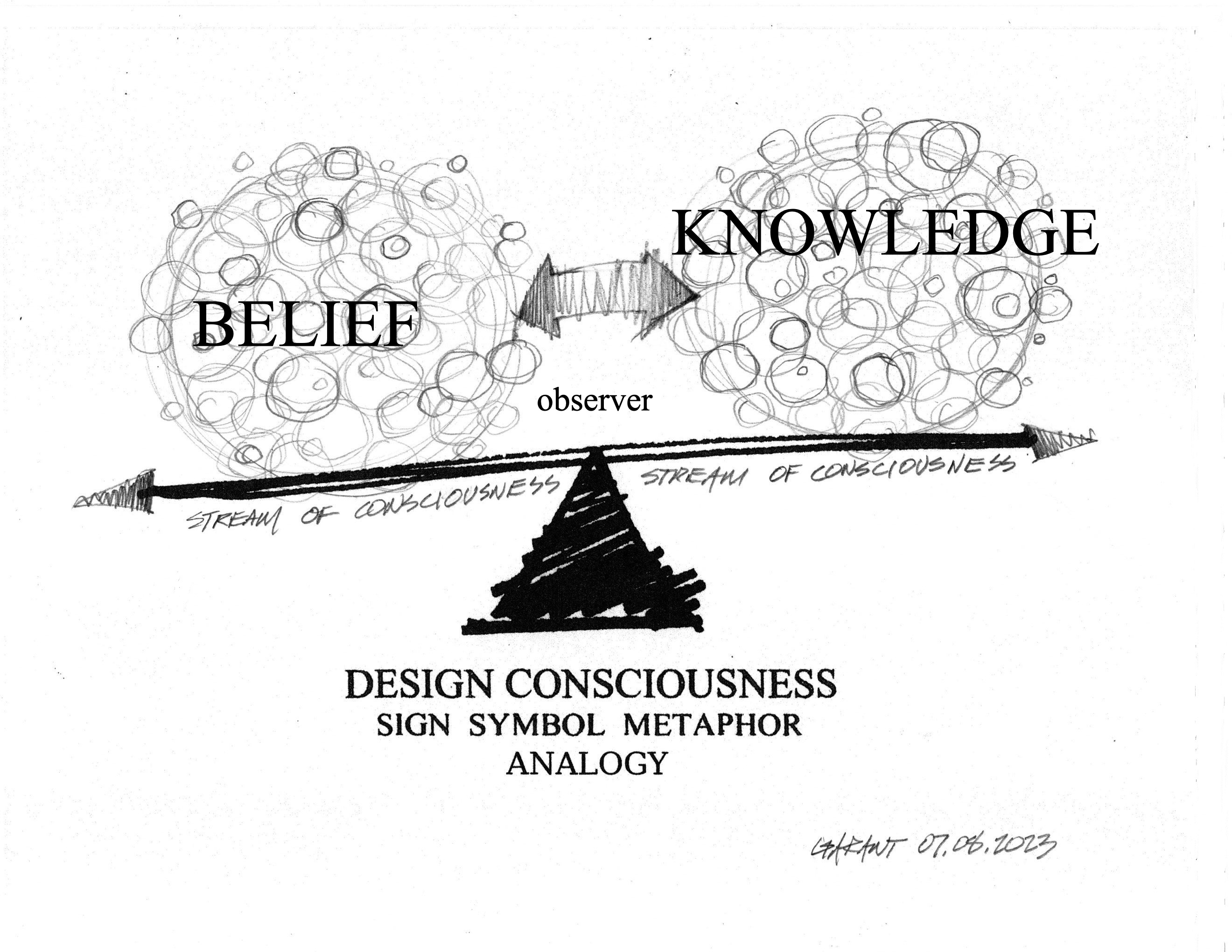
Conceptual impressions surrounding this post have yet to be substantiated, corroborated, confirmed or woven into a larger argument, context or network. Objective: To generate symbolic links between scientific discovery, design awareness and consciousness.
Abstract
Over the course of forty years of design practice, teaching, and personal investigation, a deeper understanding of design has gradually revealed itself, not merely as a discipline, but as a fundamental expression of consciousness. This realization reframes design as both ontological and epistemological: it is not only something that produces form, but something that structures how reality is perceived, interpreted, and brought into experience (Husserl, 1970; Schön, 1983).
This evolving understanding naturally converges with ancient philosophical systems, most notably Taoism. Within this tradition, the Tao represents the generative, ineffable ground of existence, a continuous unfolding process rather than a fixed entity (Laozi, trans. 1989). From this perspective emerges Oullim, or “Great Harmony,” understood here not as a static equilibrium but as a dynamic, self-regulating coherence through which design and consciousness co-participate.
Design, in this expanded context, encompasses both creation and perception. It operates as a symbolic interface, a semiotic mechanism through which human beings interpret, construct, and experience reality (Peirce, 1931–1958; Eco, 1976). Contemporary cognitive science supports this view, demonstrating that perception itself is an active, constructive process shaped by prior knowledge, embodiment, and environmental interaction (Varela, Thompson, & Rosch, 1991). It is within this symbolic system that we interpret, construct, and experience reality. It appears to emerge from the depths of a unified field of awareness, an expansive condition consistent with the Tao.
From a scientific standpoint, this perspective resonates with field-based models of reality, particularly in quantum physics, where observation plays a participatory role in determining measurable outcomes (Wheeler, 1990; Bohm, 1980). Thus, design may be understood as emerging from a unified field of awareness, a condition of latent potential consistent with both Taoist metaphysics and modern theories of complex systems.
Within this field, the interplay of yin and yang manifests as meaning and purpose, complementary forces that generate the conditions for experience, continuity, and transformation. Together, they form a living structure through which consciousness encounters and reflects upon itself.
This work therefore proposes that design be understood not merely as a human utility, but as a primary instrument of consciousness, actively participating in the unfolding of awareness.
1. Design Beginnings (Expanded)
The origins of design are commonly attributed to early human toolmaking. However, such a view reflects not the emergence of design itself, but humanity’s recognition of an already-present structuring principle. Evidence from biology, physics, and complexity theory suggests that patterned organization, what we call “design”, is intrinsic to natural systems, from cellular morphogenesis to cosmic formation (Kauffman, 1993; Mandelbrot, 1982).
Thus: Design is not invented; it is recognized.
Philosophically, this aligns with process ontology, which holds that reality is fundamentally composed of relational events rather than static objects (Whitehead, 1978). Psychologically, it corresponds to the understanding that perception is not passive but actively constructed through interaction with the environment (Gibson, 1979).

ChatGPT5.2
Early human encounters with design can therefore be understood as proto-semiotic engagements, responses to environmental patterns that were intuitively sensed before being fully conceptualized. These engagements were repeated through imitation, intuition, and reflection, gradually refining perceptual sensitivity and symbolic capacity.
Over time, these symbolic engagements enabled humans to encode and transmit both tangible survival knowledge and intangible experiential meaning, forming the basis of culture and cognition (Cassirer, 1944).
As awareness expanded, humanity increasingly recognized its interdependence with the environment. This realization initiated a process of imaginative inquiry, where perception and symbolic interpretation became intertwined. Constructivist psychology supports this view, suggesting that reality is co-created through cognitive frameworks shaped by experience (Piaget, 1970; Bruner, 1990). Over time, this arrangement refined humanity’s senses and response to the “signs” of nature.
From this perspective, design emerges as both: Mediator (between perception and action) and Methodology (for translating experience into form)
At deeper levels, repeated associations between experience and context produce what may be described as an “intelligent affirmation of being.” Phenomenology similarly describes meaning as arising through lived, embodied interaction with the world (Merleau-Ponty, 1962). These components both describe and communicate the basics of survival … both tangible and intangible.
As awareness expanded, humanity began to further recognize its’ dependency upon the environment. This recognition initiated a process of imaginative inquiry and the development of an intimate relationship between what was observed, symbolically translated and made apparent (real) in the form of both an internal and external "experience". Humans began to discover that their ability to influence their environment depended not on resistance, but on alignment.
Design emerged as both a mediator and a methodology, a symbolic bridge between perception and action.
At deeper levels, repeated associations between experience and context produce what may be described as an “intelligent affirmation of being.” Phenomenology similarly describes meaning as arising through lived, embodied interaction with the world (Merleau-Ponty, 1962).
At a critical threshold, this process gives rise to what I described as a “quickening”, a heightened sensitivity to symbolic patterns. This phenomenon parallels what psychology identifies as insight, peak experience, or heightened integrative awareness (Maslow, 1964; Kounios & Beeman, 2009).
Quickening is not merely cognitive, it is experiential, embodied, and transformative.
Observation becomes reception. The human system functions as an integrative interface, receiving, translating, and transforming environmental signals. From an information-theoretic perspective, this reflects the continuous encoding and decoding of meaning within dynamic systems (Shannon, 1948; Bateson, 1972). Design becomes both the medium and the channel through which all “forms” of energy appear.
Design, therefore, becomes both: Medium (the field of transformation) and Channel (the mechanism of transmission) Design both attracts and repulses a wide variety of frequencies in order to properly network, pattern and shape energy into its most appropriate expression. Reason: observers and contexts are always changing.
Through imagination, new associations emerge between the visible and invisible, between sensory data and abstract inference. Neuroscience suggests that such processes involve predictive modeling, where the brain continuously generates interpretations of reality (Friston, 2010).
Thus, the visible and invisible converge, forming what may be described as a shared reality between meaning and purpose. Design facilitates this exchange as a creative pulsation, continuously generating and refining experience.
By means of a cognitive imagination, new associations emerge, particularly between what is physically sensed and what cannot be seen. The visible world meets the invisible. Spirit and matter sharing in the creation of a "common reality". Design is the facilitator that enables this exchange to continually to nourish awareness and deepen understanding.
In this sense, design is simply not something we do, it is something we participate in.
2. Taoism – An Ageless Wisdom (Expanded)
Taoism offers a philosophical framework that elegantly contextualizes this expanded understanding of design. The Tao represents the underlying generative order of existence, an unnamable process from which all phenomena arise (Laozi, trans. 1989).
Like design, the Tao is not prescriptive but experiential. It resists reduction because it precedes conceptualization itself (Heidegger, 1971).
From a systems perspective, the Tao reflects principles of self-organization and dynamic equilibrium, concepts central to complexity science (Prigogine & Stengers, 1984). Design, in this sense, becomes the perceptual interface through which these processes are recognized and engaged.
Taoism offers a framework through which this deeper understanding of design can be contextualized. The Tao, often translated as “the Way,” represents the underlying order and origin of all existence.
The Taoist principle of wu wei (effortless action) suggests that optimal outcomes arise not through force, but through alignment with underlying patterns. In design terms, this corresponds to attunement rather than imposition, a principle echoed in contemporary design thinking and ecological design practices (Norman, 2013).
Design like the Tao, is not a doctrine to be followed, but a reality to be experienced. Thus, both Tao and design are best understood as processes of participation, not systems of control.
3. Taoist Principles (Expanded)
The Taoist principle of unity asserts that observer and observed are inseparable. This aligns with both phenomenology and quantum physics, where observation participates in the formation of reality (Barad, 2007; Wheeler, 1990).
The Tao suggests that all Life acts and participates in the manner of a unified whole, perpetually seeking balance and harmony, growth and awareness. This movement is not imposed but innate to Life itself. Design arises from a system of natural law while when unknown and perpetually expressing itself through the patterns of Life and nature.
The universe is not static but fluid, an ever-changing field where balance is continuously being sought by virtue of the design process. Consciousness is therefore not external it is constitutive of reality itself.
Yin and Yang as Dynamic Complementarity
Yin and yang represent complementary forces whose interaction generates change. This is consistent with: dialectical philosophy (Hegel, 1977), Systems theory (Bertalanffy, 1968), and cognitive dual-processing models (Kahneman, 2011)
Their relationship is characterized by: mutual dependence, continuous transformation and embedded reciprocity. These dynamics are not abstract they structure cognition, perception, and lived experience.
Lao Tzu’s teachings emphasize stillness, receptivity, and alignment. Rather than striving to control outcomes, one is encouraged to cultivate clarity of mind and openness to subtle influences. Action, when aligned with the Tao, becomes effortless ... an extension of natural flow rather than resistance to it.
Most importantly like Tao, design resists complete definition. Neither can be fully captured through language or rational analysis alone. Both must be entered, experienced, and lived.
For just as the Tao cannot be fully explained, design cannot be fully reduced to simple method or outcome. Both are processors of participation, engaging with a "sense of reality" that is simultaneously shaping, and being shaped, by observation.
A central principle of Taoism is unity: all things are interconnected and inseparable. The observer and the observed are not distinct entities, but aspects of a single unfolding process. This principle finds resonance in the modern understanding of the observer effect where observation influences manifestation. In reference to both perspectives, consciousness is not external to reality ... it is integral to its' being
These are not opposing forces in conflict, but complementary aspects of a unified whole. Yin represents form, stability, and receptivity. Yang represents movement, initiation, and expansion. Each exists within the other, and their interaction generates the conditions for change.
This relationship reveals several essential dynamics: Opposites define and require one another: Each nourishes and sustains the other. Each can transform into the other. Each contains a trace of the other within itself. This interplay is not an abstraction ... it is lived. It is present in every decision, every perception and every moment of awareness.
4. Design Revisited (Expanded)
The word design originates from the Latin designare ... to mark, or to signify. The term designare (“to mark, signify”) reveals design’s fundamental role as a symbolic act. Semiotically, symbols are not passive representations; they actively mediate meaning and shape experience (Peirce, 1931–1958). At its core, design is the act of creating symbols.
These symbols are not merely representations; they are communicable events through which meaning is constructed and shared. Design encompasses the processes of imagining, planning, forming, and interpreting ... all of which are inherently symbolic. Through design, we do not simply observe reality, we participate in its articulation. It organizes both subjective and objective experience, revealing patterns that connect perception across time and scale.
Design provides the framework by which objective and subjective experience are organized. It reveals certain specific underlying patterns, enabling us to interpret the forms that accompany us throughout a lifetime.
4.1 Yang’s Purpose and Yin’s Meaning (Expanded)
Within the context of design, yang may be understood as purpose; active, expansive, and generative, while yin may be understood as meaning; grounded, interpretive, and stabilizing. Together, they create a continuous exchange of energy in motion (EIM). Cognitive science supports this reciprocal loop: action informs perception, and perception reshapes action (Weick, 1995). Imbalance between meaning and purpose creates tension, requiring integrative processes such as intuition, fast, pattern-based cognition rooted in experience (Kahneman, 2011).
Design becomes the field in which these transformations are: Sensed, Structured, Expressed.

ChatGPT 5.2
Purpose initiates movement. Meaning provides form. Meaning can likewise initiate movement, as well as a purpose in the creation of a form. Yet these forces are not always in harmony. Just as the mind and emotions can come into tension, purpose and meaning can likewise struggle for precedence in the mind and emotions of the observer. Enter the intuition and its impact upon decision-making.
Neither one can exist without the other.
Purpose without meaning is directionless. Meaning without purpose is inert.
Each feeds the other. Each transforms the other, merely by means of the frameworks they project.
What once held meaning may become purposeful.
What once had purpose still has meaning ... all within an observable and perceptible instant.
Through design, this transformation can be similarly sensed and/or made visible.
Every form, every thought, every emotional impression embrace both elements ... all within the same space and time; interwoven, inseparable yet potentially divisible. This relationship extends across all scales of existence, reflecting the deeper structure of the universe itself.
5. Oullim: The Emerging Paradigm
Oullim represents the dynamic harmony that emerges from the Tao. It is not a static state, but an ongoing process of balancing, an ever-adjusting equilibrium shaped by constant change. Oullim represents dynamic harmony, not static balance. It aligns with: Homeostasis in biology, Cybernetics in systems theory (Ashby, 1956) and Neural integration in neuroscience (Siegel, 2012)

ChatGPT 5.2
Imbalance is not failure, it is the driver of adaptation and awareness.Within design, Oullim emerges as the integration of meaning and purpose into a coherent experiential field. This coherence is often accessed through intuition, which operates below conscious awareness yet plays a central role in creativity and decision-making (Damasio, 1994). Attempts to rigidly define harmony often lead to fragmentation, reflecting the limits of language (Wittgenstein, 1953). Oullim is therefore: not achieved through control, not defined through language, but realized through alignment and participation
Oullim is experienced as a centering coherence, a silent integration of thought, emotion, and perception. Design facilitates this realization by providing symbolic structures through which consciousness can engage itself. Forms and ideas become expressions, not of fixed reality, but of an ongoing articulation.
Thus: Meaning and purpose do not define harmony they participate in its expression.
Oullim exists beyond categorization yet is continuously being expressed by it. Every moment introduces imbalance. Every imbalance invites and requires restoration. This process is not a flawed ... it is the mechanism by which awareness becomes stimulated, sensitized ... consciousness expands.
Within design, Oullim manifests as a full integration of meaning and purpose. Their reciprocal relationship generates a deep sensitivity to every experience as an intuitive awareness that at times, appears to emerge out of nowhere.
The intuition is a unique form of awareness that cannot be forced or imposed upon. The intuition harbors an unseen resonance. Vibratory in structure it's rarely taught or formally considered yet is often exercised in quest for hidden knowledge and understanding. Attempts to define, attain, or control harmony can often result in fragmentation. Oullim cannot be captured through explanation alone, for language can easily become entangled in its' own cognitions and metaphors when attempting to describe and/or define it.
Instead, the intuition is harbored in experience and hidden within the field of synchronicity. Oullum is felt as a centering stillness, a silent coherence emerging from within the dynamic interplay of thought, emotion, perception and the physical world. Design plays a crucial role in this realization. Design is the symbolic process by which consciousness becomes engaged with itself. Forms, images, and ideas are not direct replications of reality, but expressions of it, designs that carry a specific meaning and purpose being "formed" into an experience or series of experiences.
Meaning and purpose cannot fully describe balance and harmony. Nor can balance and harmony be fully described as the Tao ... both must be experienced. Oullim exists beyond signs, labels and distinctions, even though it is represented by them. Oullim reveals itself not by pursuit, but through its own alignment.
Conclusion
As awareness deepens, design is revealed as a primordial condition, fundamental to a conscious universe. A process where perception, creation, and existence converge. Oullim isn’t a destination but a dynamic orientation, a stabilizing reference in continuous transformation. Oullim is not something that is entirely achievable but rather represents a series of flags designed to help us remain centered and focused on our path.
References
- Ashby, W. R. (1956). An introduction to cybernetics. Chapman & Hall.
- Barad, K. (2007). Meeting the universe halfway. Duke University Press.
- Bateson, G. (1972). Steps to an ecology of mind. University of Chicago Press.
- Bertalanffy, L. von. (1968). General system theory. George Braziller.
- Bohm, D. (1980). Wholeness and the implicate order. Routledge.
- Bruner, J. (1990). Acts of meaning. Harvard University Press.
- Cassirer, E. (1944). An essay on man. Yale University Press.
- Damasio, A. (1994). Descartes’ error. Putnam.
- Eco, U. (1976). A theory of semiotics. Indiana University Press.
- Friston, K. (2010). The free-energy principle. Nature Reviews Neuroscience, 11(2), 127–138.
- Gibson, J. J. (1979). The ecological approach to visual perception. Houghton Mifflin.
- Hegel, G. W. F. (1977). Phenomenology of spirit. Oxford University Press.
- Heidegger, M. (1971). Poetry, language, thought. Harper & Row.
- Husserl, E. (1970). The crisis of European sciences. Northwestern University Press.
- Kahneman, D. (2011). Thinking, fast and slow. Farrar, Straus and Giroux.
- Kauffman, S. (1993). The origins of order. Oxford University Press.
- Kounios, J., & Beeman, M. (2009). The Aha! moment. Current Directions in Psychological Science, 18(4), 210–216.
- Laozi. (1989). Tao Te Ching (S. Mitchell, Trans.). Harper & Row.
- Mandelbrot, B. (1982). The fractal geometry of nature. W.H. Freeman.
- Merleau-Ponty, M. (1962). Phenomenology of perception. Routledge.
- Norman, D. (2013). The design of everyday things. Basic Books.
- Peirce, C. S. (1931–1958). Collected papers. Harvard University Press.
- Piaget, J. (1970). Psychology and epistemology. Penguin.
- Prigogine, I., & Stengers, I. (1984). Order out of chaos. Bantam.
- Schön, D. (1983). The reflective practitioner. Basic Books.
- Shannon, C. E. (1948). A mathematical theory of communication. Bell System Technical Journal, 27, 379–423.
- Siegel, D. J. (2012). The developing mind. Guilford Press.
- Varela, F., Thompson, E., & Rosch, E. (1991). The embodied mind. MIT Press.
- Weick, K. (1995). Sensemaking in organizations. Sage.
- Wheeler, J. A. (1990). Information, physics, quantum. Addison-Wesley.
- Whitehead, A. N. (1978). Process and reality. Free Press.
- Wittgenstein, L. (1953). Philosophical investigations. Blackwell.
The author generated some of this text in part with ChatGPT 5.2 OpenAI’s large-scale language-generation model. Upon generating draft language, the author reviewed, edited, and revised the language to their own liking and takes ultimate responsibility for the content of this publication.
* * *
* * *

To know is your own creation."
Anonymous

Edited: 04.10.2026, 04.12.2026, 04.14.2026
Find your truth. Know your mind. Follow your heart. Love eternal will not be denied. Discernment is an integral part of self-mastery. You may share this post on a non-commercial basis, the author and URL to be included. Please note … posts are continually being edited. All rights reserved. Copyright © 2026 C.G. Garant.