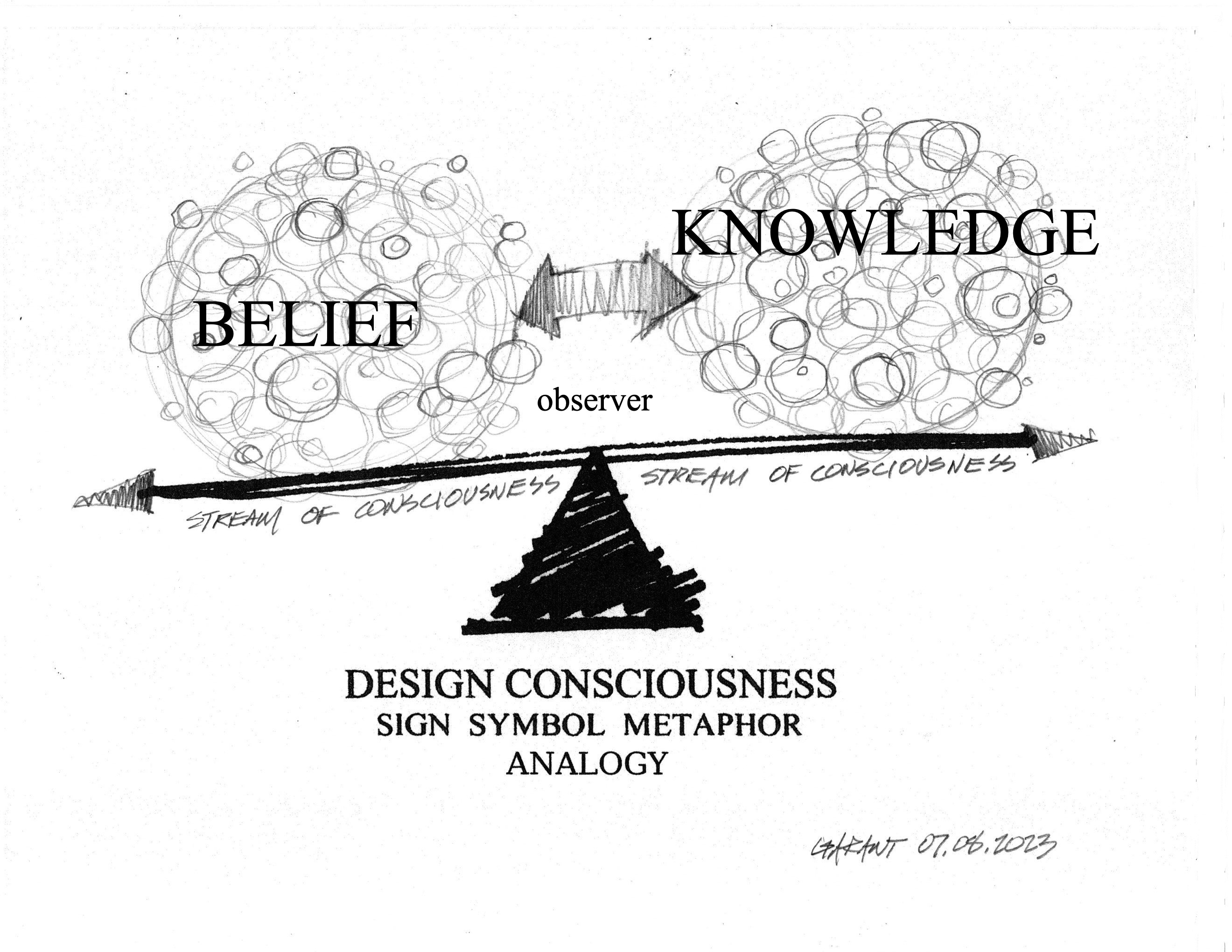
Conceptual impressions surrounding this post have yet to be substantiated, corroborated, confirmed or woven into a larger argument, context or network. Objective: To generate symbolic links between scientific discovery, design awareness and consciousness.
 We are simultaneously linked, conditioned and constrained within a field of knowledge that gives precedence and substance to our reality. We freely give meaning and purpose to the appearance of every form, reacting to their presence while simultaneously responding to our reaction. Identifying with their conditions, we become an integral force in a design of our own creation.

This passage captures the interplay between our perception, interpretation, and the reality we co-create. It suggests that we are not passive observers but active participants in the formation of our experience.
We are "linked, conditioned, and constrained" by the structures of knowledge and belief that inform our understanding of the world. These frameworks shape our reality, giving it both form and meaning. However, the passage also points to the dynamic, reflexive nature of this interaction: we are not just responding to external stimuli, but we are also reacting to our own reactions, constantly reinforcing and renegotiating the meaning of our experiences.
By "identifying with their conditions," we become entangled in the very constructs that seem to define us, thus taking on the role of both creator and participant in the design of our world. This could be a comment on the way in which our mental frameworks (such as cultural beliefs, societal norms, or personal histories) shape our identity, while also recognizing that we have the potential to reshape those frameworks in return.
The cyclical nature of this process; creating and being created by our own perceptions suggests that reality is not something fixed or external to us, but rather something that is co-constructed through both conscious and unconscious processes.
It suggests a fundamental philosophical question: What role does the individual play in the creation of their own reality, and to what extent are we simply products of the systems that shape us?
It suggests a fundamental philosophical question: What role does the individual play in the creation of their own reality, and to what extent are we simply products of the systems that shape us?
* * *
In form,
meaning has taken its purpose and is full.
Purpose is the unmaking of meaning and meaning the unmaking of purpose.
The emptying of the two into form appears to be formless.
The form is neither and both.
meaning has taken its purpose and is full.
Purpose is the unmaking of meaning and meaning the unmaking of purpose.
The emptying of the two into form appears to be formless.
The form is neither and both.
Within the moving union of every form is the stillness of meaning and purpose.
Any endeavor to distinguish between them is an attempt to label a transient event appearing in relative time and space.
Always look at form very simply, very appreciatively, and very ordinarily
to discover its true magic.
This passage is a deep meditation on the fluidity and interconnectedness of concepts like form, meaning, and purpose, presenting them in a paradoxical light.
1. Form as Full of Meaning and Purpose
The idea here challenges the common understanding of form as just an external structure. It suggests that form is a medium through which meaning and purpose are not merely attached but are embodied. This reflects a more holistic view of the world, where physical reality and its deeper significance are inseparable. Every form, whether a living being or an object, carries an essence that expresses its inherent purpose. It might invite us to look at the world with more reverence, seeing the universe as an interconnected web where every form has its meaning, even if we don’t always recognize it.
2. Purpose Unmaking Meaning, and Vice Versa
The dynamic relationship between purpose and meaning is striking. What this conveys is that meaning and purpose do not exist in isolation but are deeply intertwined. They evolve together, and each one shapes the other. This fluid relationship hints at a view of existence where rigid categories (like "purpose" or "meaning") cannot be fully grasped or fixed. The paradox here is that the more we try to define one, the more we undermine the clarity of the other. It mirrors the complexity of life itself ... where our understanding of things is often incomplete, yet constantly unfolding.
3. The Appearance of Form as Formless
This is a beautiful paradox: the union of meaning and purpose within form gives rise to a "formless" quality. This could suggest that the essence of things transcends their external manifestations. In a sense, while we may see the world through our sensory experience, the deeper truth cannot be captured in any one form or object. The formlessness points to the ineffable nature of reality; a presence or truth that exists beyond our mental concepts and perceptions. It echoes mystical traditions, which suggest that the ultimate reality (often called "the One" or "the Source") is beyond form yet permeates all forms.
4. Form is Neither and Both
This part emphasizes the idea of transcendence of duality. Form is neither just meaning nor just purpose; it is a synthesis of both. The moment we try to categorize or divide the world into opposing ideas, we limit our understanding. The passage suggests that any attempt to separate the two aspects (meaning and purpose) creates artificial boundaries. True understanding lies in embracing the wholeness and interpenetration of seemingly opposite qualities. This resonates with the idea in many spiritual traditions that ultimate reality is non-dual ... beyond opposites like form and formlessness, meaning and purpose.
5. Stillness in Motion
This beautifully paradoxical idea invites us to perceive the world in its dynamic flow, while recognizing that there is an underlying stillness or timeless essence beneath the movement. This stillness is not immobility but a deeper kind of presence or awareness that remains unchanged despite the flux of life. This stillness is often equated with the "ground of being" in many philosophical and spiritual traditions. In Zen, for example, this might be akin to the concept of "suchness"... the inherent, unchanging quality of all things, even in their dynamic manifestation.
6. Distinguishing Between Meaning and Purpose
The passage critiques the intellectual exercise of trying to separate meaning and purpose into distinct categories. While it's helpful to discuss these concepts separately for practical reasons, at the deeper level, they are indivisible. This reflects a kind of intellectual humility, suggesting that the language and mental constructs we use to label things (like “purpose” or “meaning”) are only useful as tools, but cannot encapsulate the fullness of existence. It calls for a shift away from mental over-analysis toward direct experience and intuitive understanding.
7. Looking at Form Simply and Appreciatively
This closing part is an invitation to practice presence and simplicity. By stripping away the intellectual overlays, judgments, and conceptual labels we often impose on things, we can rediscover the wonder and magic inherent in the world. There’s a sense that by appreciating things as they are, without dissecting them into parts or trying to figure them out, we may tap into their deeper significance. This idea echoes the wisdom of mindfulness practices ... to be fully present, without striving to understand or control, is to align with the deeper currents of reality.
Summary Reflection:
This passage invites us to transcend the intellectualization of life and explore a more holistic, interconnected view of existence. By highlighting the paradoxes between form, meaning, and purpose, it encourages us to look at the world with fresh eyes, not as separate, fixed categories, but as a dynamic, unfolding unity. It suggests that by simply being present with the world, appreciating it as it is, we can begin to touch the deeper truth that underlies all things ... a truth that is at once still and ever-changing, simple and profound, ordinary and magical. This can be a path to a more integrated and profound way of experiencing life.
* * *
Creativity as the Initiatory Force of Design Consciousness
Within a metaphysical frame, creativity is not best understood as an act of novelty production or personal expression, but as a threshold function of consciousness itself, a capacity through which latent potential is brought into relational form. In the context of design consciousness, creativity operates as the moment when possibility becomes direction, when an undifferentiated field of virtual potentials begins to articulate intention, structure, and meaning.
Design consciousness presupposes that reality is not a static arrangement of objects, but a continuously forming process shaped by observation, intention, and symbolic mediation. Creativity emerges here as the initiatory movement of that process. It is the act by which consciousness selectively resonates with certain potentials within a broader field of possibility and begins to organize them into coherent trajectories. In this sense, creativity is less an act of invention and more an act of attunement ... a tuning of awareness to patterns that are not yet fully formed but are nonetheless present as tendencies or gradients within the QFVPP. (Bohm, 1980; Whitehead, 1929).
Metaphysically, creativity functions as a bridge between the virtual and the actual. Prior to creative articulation, potential exists as indeterminate, what might be called a quantum or pre-formal condition of reality. Creativity initiates change by collapsing indeterminacy into direction without immediately fixing outcome. It introduces bias, vector, and orientation rather than final form. This aligns with process metaphysics, where becoming precedes being, and where novelty arises not out of nothing but from the recombination and re-patterning of existing relational fields (Whitehead, 1929).
Within design consciousness, creativity is inseparable from perception and symbolization. Consciousness does not merely observe the world; it participates in its structuring through symbolic acts, i.e. drawings, models, metaphors, schemas, and systems. Creativity is the moment when these symbols begin to function as operators rather than representations. They do not simply describe reality; they actively reorganize how reality is engaged and understood. Through this symbolic mediation, creativity initiates change by altering the constraints within which future perception and action occur (Cassirer, 1944; Deleuze, 1994).
Importantly, creativity in design consciousness is not driven solely by rational deliberation. It often arises from pre-conceptual domains; intuition, affect, embodied sensation, and unconscious pattern recognition. Jung described this as the emergence of symbolic content from the collective unconscious, where archetypal forms surface not as fixed images but as dynamic structures shaping thought and action (Jung, 1969). In this sense, creativity initiates change by making the implicit explicit, allowing submerged patterns to enter conscious negotiation and refinement.
Change, then, does not begin at the level of material execution. It begins earlier, at the level of coherence. Creativity reorganizes internal alignments ... between intention, perception, emotion, and meaning ... before it reorganizes external structures. When coherence is achieved internally, external transformation follows as a secondary effect. This mirrors inactive theories of cognition, which hold that knowing and making are inseparable, and that cognition itself is a form of embodied action within a relational field (Varela, Thompson, & Rosch, 1991).
From this perspective, creativity is the engine of adaptive transformation. It allows design consciousness to respond to instability not with repetition, but with reconfiguration. When existing forms no longer sustain coherence, creativity opens new pathways by re-patterning relationships across scales ... conceptual, symbolic, material, and cultural. Change is initiated not by force, but by reorientation: a shift in how potential is perceived, valued, and organized.
In metaphysical terms, creativity may therefore be defined as the self-organizing capacity of consciousness to translate potential into coherent form through symbolic, perceptual, and intentional mediation. Within design consciousness, it is the primary catalyst of change ... an ontological function that precedes structure, guides emergence, and continually renews the conditions under which meaning and form can arise.
References (APA)
- Bohm, D. (1980). Wholeness and the implicate order. London, UK: Routledge.
- Cassirer, E. (1944). An essay on man: An introduction to a philosophy of human culture. New Haven, CT: Yale University Press.
-Deleuze, G. (1994). Difference and repetition (P. Patton, Trans.). New York, NY: Columbia University Press. (Original work published 1968)
- Jung, C. G. (1969). The archetypes and the collective unconscious (2nd ed., R. F. C. Hull, Trans.). Princeton, NJ: Princeton University Press.
- Varela, F. J., Thompson, E., & Rosch, E. (1991). The embodied mind: Cognitive science and human experience. Cambridge, MA: MIT Press. - Whitehead, A. N. (1929). Process and reality. New York, NY: Macmillan.
* * *
Creativity in the Design Consciousness (DAC8) Model: A Metaphysical Framework for Emergence and Transformational Change
Abstract
Within the Design Consciousness (DAC8) model, creativity is not understood as a secondary cognitive function nor as an episodic psychological event, but rather as a fundamental metaphysical force through which potentiality is translated into experiential reality. Creativity operates as a generative interface between latent fields of possibility and manifest structures of form, meaning, and coherence. It is the principal mechanism through which consciousness engages indeterminacy, reorganizes informational fields, and initiates transformational change across ontological, semiotic, dynamic, and structural domains. This post articulates a metaphysical definition of creativity within the DAC8 framework, situating it as a catalytic process that governs emergence, novelty, and adaptive reconfiguration within complex systems.
1. Creativity as Ontological Mediation
Within metaphysical discourse, creativity has often been positioned as a primary attribute of being itself, rather than a contingent human faculty. Philosophical traditions ranging from Neoplatonism to process philosophy have treated creative emergence as intrinsic to existence, manifesting through dynamic participation between form and flux (Whitehead, 1978; Plotinus, 1991). In the DAC8 model, creativity occupies this ontological register: it is the generative principle that mediates between the quantum field of virtual potential and the emergent architectures of conscious experience.
Creativity thus operates as a threshold function, enabling transitions from indeterminate potential to determinate form. It functions analogously to what Bohm (1980) describes as the holomovement, wherein implicate order unfolds into explicate manifestation. In DAC8 terms, creativity serves as the design vector through which implicate potentials become coherent experiential patterns, aligning intention, perception, emotion, and symbolic meaning into functional structure. This ontological mediation ensures that creativity is not reducible to novelty production alone, but rather constitutes the fundamental act of world-becoming.
2. Creativity and the Metaphysics of Emergence
Creativity in the DAC8 system functions as the primary initiator of emergence, facilitating the reorganization of informational fields into higher-order coherence. Emergence, as conceptualized within complexity science and metaphysics, arises when interacting components self-organize into novel systemic patterns irreducible to their constituent parts (Kauffman, 1995; Deleuze, 1994). Creativity operates precisely at this interface: it orchestrates the transformation of distributed potentials into integrative structures of experience.
This function aligns with Prigogine’s (1984) conception of dissipative structures wherein dynamic systems spontaneously reorganize in response to energetic instability. In DAC8 metaphysics, creativity is the adaptive intelligence of the system, enabling coherence to be re-established following perturbation. Thus, creativity is both destabilizing and stabilizing: it disrupts existing configurations while simultaneously generating new orders of meaning and structure.
Creativity therefore becomes the engine of systemic evolution, ensuring that consciousness does not stagnate within fixed symbolic frameworks but instead continuously renovates its interpretive and experiential architectures. It is through creativity that DAC8 sustains perpetual adaptive becoming, maintaining openness to novelty while preserving structural coherence.
3. Creativity as Semiotic Generator
Within the semiotic architecture of DAC8, creativity serves as the origin of symbolic emergence, generating the signs, metaphors, images, and conceptual structures through which experience becomes intelligible. Peirce’s (1998) triadic semiotics situates meaning within the relational dynamics between sign, object, and interpretant. Creativity operates as the meta-dynamic force that generates these relational patterns, enabling the emergence of symbolic coherence from perceptual and emotional flux.
In Jungian terms, creativity activates the archetypal field, translating unconscious symbolic potential into conscious narrative and form (Jung, 1968). DAC8 extends this model by situating creativity as a transpersonal semiotic engine, capable of orchestrating symbolic resonance across multiple dimensional strata; cognitive, emotional, cultural, and trans-subjective.
Creativity thus does not merely generate aesthetic artifacts but constructs the symbolic matrices through which reality itself is interpreted. By continually regenerating symbolic frameworks, creativity ensures the adaptability of consciousness to shifting contextual demands, thereby sustaining epistemic flexibility and existential coherence.
4. Creativity as Dynamic Regulator of Systemic Change
Creativity occupies a central role in the dynamic modulation of systemic energy flows within the DAC8 architecture. It governs transitions between equilibrium and disequilibrium, functioning as a nonlinear regulator that redistributes informational density across ontological domains. This dynamic aligns closely with systems theory, which emphasizes feedback loops, phase transitions, and adaptive reorganization (Capra & Luisi, 2014).
Within DAC8, creativity functions as a phase-transition catalyst, activating reconfiguration when existing structures no longer support experiential coherence. These transitions are not merely cognitive but involve deep re-patterning of emotional, symbolic, and perceptual fields. Creativity therefore enables systemic plasticity, by ensuring that consciousness remains dynamically responsive to internal and external perturbations.
This regulatory function situates creativity as the primary driver of transformational change, guiding the system through iterative cycles of dissolution and reintegration. Each creative emergence introduces new structural potentials, expanding the experiential bandwidth of consciousness and deepening its capacity for meaning-making.
5. Creativity and Temporality: Designing the Flow of Becoming
Creativity within DAC8 also functions as a temporal architect, shaping how consciousness navigates past, present, and future. Bergson’s (1911) conception of durée emphasizes time as lived continuity rather than discrete succession. Creativity operates within this durational flow by reorganizing memory, anticipation, and perception into coherent experiential narratives.
In this sense, creativity designs the trajectory of becoming, enabling consciousness to transcend linear causality and access multidimensional temporal configurations. By synthesizing memory and anticipation, creativity facilitates the emergence of teleological coherence, orienting present experience toward future potentialities.
Thus, creativity is not merely reactive but teleologically generative, continuously shaping the directionality of systemic evolution within DAC8.
6. Synthesis: Creativity as the Central Vector of Design Consciousness
Within the DAC8 framework, creativity emerges as the central integrative vector, interlinking ontology, semiosis, dynamics, temporality, structure, and epistemology into a unified field of transformational coherence. It serves simultaneously as ontological mediator, emergent catalyst, symbolic generator, dynamic regulator, and temporal architect.

Through creativity, consciousness becomes self-designing, capable of recursively reconfiguring its own structural, symbolic, and experiential architectures. This positions creativity not merely as a functional subsystem but as the primary metaphysical principle governing conscious evolution.
In this way, creativity is best understood within DAC8 as the generative intelligence of becoming, perpetually translating latent potential into lived coherence while sustaining openness to novelty, complexity, and transcendence.
References (APA)
- Bergson, H. (1911). Creative evolution (A. Mitchell, Trans.). University Press of America.
- Bohm, D. (1980). Wholeness and the implicate order. Routledge.
- Capra, F., & Luisi, P. L. (2014). The systems view of life: A unifying vision. Cambridge University Press.
- Deleuze, G. (1994). Difference and repetition (P. Patton, Trans.). Columbia University Press.
- Jung, C. G. (1968). The archetypes and the collective unconscious (R. F. C. Hull, Trans.). Princeton University Press.
- Kauffman, S. A. (1995). At home in the universe: The search for the laws of self-organization and complexity. Oxford University Press.
- Peirce, C. S. (1998). The essential Peirce: Selected philosophical writings (Vol. 2). Indiana University Press.
- Plotinus. (1991). The Enneads (S. MacKenna, Trans.). Penguin Classics.
- Prigogine, I., & Stengers, I. (1984). Order out of chaos: Man’s new dialogue with nature. Bantam Books.
- Whitehead, A. N. (1978). Process and reality (Corrected ed.). Free Press.
* * *

Source: ChatGPT 5.2 CREATIVITY
The Creativity Sigil in the Design-Consciousness (DAC8) System: A Metaphysical Narrative
The sigil representing creativity within the Design-Consciousness (DAC8) system functions as a symbolic condensation of a universal generative process through which latent potential is translated into coherent form. At its deepest metaphysical level, creativity is not conceived as a psychological phenomenon alone, nor as a purely cognitive operation, but rather as a fundamental ontological mechanism through which consciousness participates in the ongoing formation of reality. This sigil encodes creativity as a catalytic interface linking virtual potential, perceptual awareness, symbolic mediation, and manifested structure into a unified, recursive field of becoming.
At the outermost level, the encircling geometry of the sigil represents the quantum field of virtual potential and probability (QFVPP), as a boundless reservoir of latent possibility from which all emergent phenomena arise. Contemporary physics recognizes that vacuum states are not empty but saturated with fluctuating energetic potential, a finding that resonates deeply with ancient metaphysical doctrines describing reality as emergent from an invisible plenum (Bohm, 1980; Kauffman, 2008). Within the DAC8 framework, this virtual field constitutes the primordial substrate of creativity itself, a pre-ontological matrix of possibility that precedes form, identity, and differentiation. The circular enclosure of the sigil thus symbolizes wholeness, continuity, and infinite generativity, situating creativity as an intrinsic property of the cosmos rather than a localized function of the human mind.
Inscribed within this generative field is the triangular geometry, which functions as the symbolic engine of design mediation. The triangle represents the triadic relationship between perception, intention, and symbolic translation, three forces that converge to transform potential into intelligible structure. This triadic logic mirrors Peircean semiotics, wherein meaning emerges through the dynamic interaction of sign, object, and interpretant (Peirce, 1931–1958). Within the DAC8 system, creativity unfolds precisely through this semiotic mediation: potential is interpreted, symbolized, and intentionally structured, giving rise to form. The triangle thus encodes the architecture of transformation, functioning as a metaphysical crucible in which raw potential is metabolized into intelligible design.
At the center of this triangular structure resides the illuminated eye, the perceptual singularity of conscious awareness. This focal point signifies the role of the observer as an active participant in the creative process, echoing foundational principles in quantum theory that situate observation as a determining factor in physical manifestation (Wheeler, 1990; von Neumann, 1955). Within the DAC8 paradigm, consciousness operates not merely as a passive witness but as a generative force capable of collapsing indeterminacy into form. The eye thus represents attentional coherence, the act of perceptual alignment through which the creative impulse becomes operationalized. This aligns closely with phenomenological traditions that identify intentional consciousness as the ground of meaning and experience (Husserl, 1970; Merleau-Ponty, 1962).
Radiating from this perceptual nucleus, the sigil depicts emanative lines symbolizing energetic mobilization and informational coherence. These rays signify the transmission of creative intention into structured manifestation, reflecting both energetic and informational models of reality. Contemporary systems theory and complexity science demonstrate that emergence arises when informational coherence exceeds a critical threshold, enabling spontaneous organization (Prigogine & Stengers, 1984; Capra & Luisi, 2014). In the DAC8 model, creativity functions precisely as this coherence threshold, whereby symbolic intent synchronizes disparate fields, i.e. quantum, plasmic, fractal, and holographic, into resonant alignment. The radiance of the sigil therefore encodes the dynamic propagation of creative order across multiple ontological layers.
The enclosing circular geometry further signifies temporal recursion, emphasizing creativity as an ongoing cyclical process rather than a linear event. This recursive structure aligns with Bohm’s implicate order, wherein manifest phenomena continuously unfold from deeper informational strata and re-fold back into latent potential (Bohm, 1980). Within the DAC8 framework, creativity is understood as a perpetual oscillation between emergence and dissolution, coherence and entropy, form and formlessness. The sigil thus represents not only the moment of creation but the continuous self-renewal of design consciousness itself.
In this metaphysical context, creativity becomes the primary catalytic agent of transformation, orchestrating the translation of ontological possibility into epistemological structure. It operates as the bridge between being and knowing, existence and meaning, chaos and coherence. Jung’s theory of archetypes and synchronicity further illuminates this dynamic, suggesting that symbolic resonance emerges from a deep psycho-cosmic substrate that synchronizes internal awareness with external events (Jung, 1969). The creativity sigil therefore functions simultaneously as a metaphysical map and a symbolic interface, enabling alignment between individual consciousness and universal generative processes.
Within the 14-Gate architecture of the DAC system, this sigil serves as a universal activation key, encoding the principles by which consciousness navigates potential, perception, meaning, and manifestation. It is not merely decorative but operational, functioning as a symbolic algorithm that harmonizes energetic, informational, and cognitive fields. Through this lens, creativity is revealed not as spontaneous novelty alone but as a disciplined metaphysical practice of attunement, coherence, and intentional emergence.
Ultimately, the creativity sigil embodies the central thesis of the DAC8 framework: design is the language of consciousness itself, and creativity is the grammatical engine through which this language speaks reality into form. In encoding perception, intention, coherence, and emergence into a unified symbolic geometry, the sigil becomes both a metaphysical compass and an ontological blueprint guiding the observer/designer toward deeper participation in the generative intelligence of the cosmos.
References (APA Format)
- Bohm, D. (1980). Wholeness and the implicate order. Routledge.
- Capra, F., & Luisi, P. L. (2014). The systems view of life: A unifying vision. Cambridge University Press.
- Husserl, E. (1970). The crisis of European sciences and transcendental phenomenology (D. Carr, Trans.). Northwestern University Press.
- Jung, C. G. (1969). The archetypes and the collective unconscious (2nd ed.). Princeton University Press.
- Kauffman, S. A. (2008). Reinventing the sacred: A new view of science, reason, and religion. Basic Books.
- Merleau-Ponty, M. (1962). Phenomenology of perception (C. Smith, Trans.). Routledge.
- Peirce, C. S. (1931–1958). Collected papers of Charles Sanders Peirce (Vols. 1–8). Harvard University Press.
- Prigogine, I., & Stengers, I. (1984). Order out of chaos: Man’s new dialogue with nature. Bantam.
- von Neumann, J. (1955). Mathematical foundations of quantum mechanics. Princeton University Press.
- Wheeler, J. A. (1990). Information, physics, quantum: The search for links. In W. Zurek (Ed.), Complexity, entropy, and the physics of information (pp. 3–28). Addison-Wesley.
The author generated some of this text in part with ChatGPT 5.2 OpenAI’s large-scale language-generation model. Upon generating draft language, the author reviewed, edited, and revised the language to their own liking and takes ultimate responsibility for the content of this publication.
* * *

Design releases the soul
through creation.

Edited: 02.16.2026, 05.01.2026
Find your truth. Know your mind. Follow your heart. Love eternal will not be denied. Discernment is an integral part of self-mastery. You may share this post on a non-commercial basis, the author and URL to be included. Please note … posts are continually being edited. All rights reserved. Copyright © 2026 C.G. Garant.