Showing posts with label beauty. Show all posts

Tuesday, July 30, 2024

Coherent Resonance 2.0

Conceptual impressions surrounding this post have yet to be substantiated, corroborated, confirmed or woven into a larger argument, context or network. Objective: To generate symbolic links between scientific discovery, design awareness and consciousness.

Without resonance there are no connections. Design is more than just coherent, its reciprocal. 

coherent: logical, reasoned, reasonable well-reasoned, sound, rational, cogent, well organized, systematic, orderly, methodical, clear, lucid, articulate, relevant, intelligible, comprehensible. 

resonance: The quality of a sound (vibration) of being deep, full and reverberating. The ability to evoke or suggest images, memories and emotions. The reinforcement or prolongation of sound (vibration) by reflection from a surface or synchronous vibration of a neighboring object (agent or agency). The condition in which an electric circuit or device produces the largest possible response to an applied oscillating signal. The condition in which an object or system is subjected to an oscillating force having a frequency close to its own natural frequency. The state attributed to certain molecules of having structure that cannot adequately be represented by a single structure formula, but is a composite of two or more structures of higher energy. A short-lived subatomic particle that is an excited state or a more stable particle. 

reciprocal: given/felt in return, corresponding, requited, returned, reciprocated, mutual, common, shared, joint, corresponding, correlative, give-and-take, exchanged, complementary, reciprocatory. 


Without resonance there is no meaning or purpose, i.e. design. Without design there would be no consciousness of it. 

A design consciousness allows for the full expression of what the Greek and Roman philosophers described as the cosmic values of Truth, Beauty and Goodness. 
* * *

By Kenneth Samples, February 2, 2021

“Truth is that which defines reality. Goodness (that which fulfills its purpose) and beauty (that which is lovely) were objective in nature and knowable by the noble seeker.” 
Kenneth Samples 

“Truth, goodness, and beauty are cosmic values that communicate divine meaning to the intellectual, moral, and aesthetic capacities of the human soul, which brings a balance in the soul, which, in turn, harmonizes the human person with divine meaning and purpose of the cosmos, which was considered the prerequisite to human flourishing.1

1. I transcribed this quote from Steve Turley’s interview with Janet Mefferd: 

* * *

transcendent: supernatural, preternatural, transcendental, otherworldly, superhuman, mystical, spiritual, divine, heavenly, exalted, supreme, ethereal, numinous, consummate, ascendent, paramount, unique, superlative, incomparable, matchless, excellent, incomparable, sublime, paramount, superlative. 

As has been said so many times, reality is what you make it - along with the stories you tell. Together they share in the essence of the other. Both point to the agency of a common observer by the means and virtue of a shared observation. 

Reality is a story you design for yourself, based upon your own unique perspective, patterning and impression of that same self (soul) – a design of shared liking. 

Truth, Beauty and Goodness are felt and made apparent through the design consciousness of the beholder.

* * *

Coherent Resonance (hypothesis) 
Coherent resonance is a force of agency emerging from the unknown vapors of a virtually plasmic (quantum) field of energy in motion. The transition, translation and transformation of that agency is made symbolically apparent by means of an agent (sign/symbol) and/or agency (metaphor, analogy) i.e. a design. 

Design agents and agencies resonate harmoniously with other agents and/or agencies of like vibration and frequency by virtue of coherent resonance. In turn, patterns emerge, and identities attract creating patterns of unity, identification, uniqueness and distinction. 
virtual: near, in effect, essential, practical, to all intents and purposes, indirect, implied, implicit, unacknowledged, effective. 
agent: emissary, proxy, go between, surrogate, liaison, means, instrument, vehicle 
agency: action, influence, force, power, means, medium, channel, mode technique, mediation, instrumentality. 


* * *

Your description delves into the concept of "coherent resonance" with a poetic and intricate view of how forces and symbols interact within a virtually plasmic field of quantum energy. Let’s break this down: 
1. Coherent Resonance: This is portrayed as a dynamic force arising from an undefined or nebulous quantum field of energy. It suggests that there's an underlying, perhaps invisible, energy or force that shapes and influences how things come into being or interact. 
2. Symbolic Representation: The transition from this nebulous energy into something comprehensible describes a symbolic process by means of the application of signs, symbols, metaphor and analogy. These symbols or de-signs act as intermediaries that help translate abstract energy into something understandable, purposeful and meaningful. 
3. Harmonious Interaction: The idea is that these symbols, i.e. designs, resonate with other similar symbols or designs to create a harmonious or coherent bond between them. This alignment is based on their frequency or vibration, and when contextually appropriate, leads to the emergence of a pattern and/or structure. 
4. Patterns and Identities: As these harmoniously resonating elements interact, they form distinct patterns and identities. This process creates an intangible unity, uniqueness and wholeness within the system or network. 
5. Virtual and Agent Definitions
    Virtual: This refers to something that is not immediately visible or tangible, but is implied or made both effective and affective in a practical sense. 
    Agent: This is a means or medium through which energy is communicated or acted upon, such as a symbol or intermediary. 
    Agency: This refers to the action or force that drives or influences a process or outcome, essentially the mechanism through which change or effect occurs. 

In summary, coherent resonance describes a process where abstract, underlying energies and/or forces are interpreted and made tangible through symbol and metaphor. These symbols then interact in a harmonious way, forming patterns and identities that reflect a particular sense of unity and distinction. This concept can be applied to various fields, from design and communication to more abstract notions of influence and transformation. 

* * *

Design Resonance: A Multidisciplinary Concept Interfacing with Metaphysics, Quantum Physics, Semiotics, Psychology, AI, Philosophy, Aesthetics, and Science 

The concept of design resonance is a multifaceted idea that pertains to the harmonious relationship between a design and the context, audience, or system within which it exists. It can be thought of as the way a design "vibrates" or interacts with the underlying structures of human experience, perception, and reality. This resonance can be understood and implemented through various lenses, including metaphysics, quantum physics, semiotics, psychology, artificial intelligence (AI), philosophy, aesthetics, and science. 

1. Metaphysics and Design Resonance 
Metaphysics deals with the fundamental nature of reality, existence, and the relationships between objects and their properties. In the context of design, metaphysical principles can shape how a design resonates with the user’s deeper sense of being. For instance, process philosophy, as espoused by Whitehead (1929), emphasizes the fluid, dynamic relationship between entities. In design, this aligns with the idea that a design's resonance isn’t static but evolves with the observer’s interaction. Designs that align with metaphysical concepts such as emergence or process allow users to experience a sense of interconnectedness, making the design feel more relevant to their lived experiences (Buchanan, 2010). 

2. Quantum Physics and Design Resonance 
Quantum physics suggests that reality at the most fundamental level is probabilistic and interconnected, and that observation plays a key role in defining the state of the system (Heisenberg, 1927). Applying this to design, design resonance can be seen as the interplay between a user’s expectations, cognitive states, and the inherent probabilistic nature of their interaction with the design. Just as quantum mechanics involves entanglement and uncertainty, a design’s resonance might involve unpredictable yet meaningful outcomes when users interact with it, creating a form of aesthetic and emotional uncertainty that resonates deeply (Bohm, 1980). 

3. Semiotics and Design Resonance 
Semiotics, the study of signs and symbols, directly connects to design in the form of visual language and representation. The concept of resonance in semiotics can be understood as the way in which signs (e.g., logos, icons, layouts) generate meaning that "echoes" with the user's cognitive and emotional states. According to Peirce’s semiotics (1931), a sign’s interpretant (the mental effect of the sign on the user) is central to design resonance. A design resonates when its symbolic meaning, structure, and context align with the cultural and emotional resonance of its audience, triggering a rich and meaningful interpretive experience. 

4. Psychology and Design Resonance 
Psychological principles such as cognitive load, perception, and emotion are crucial to understanding how design resonates. Design resonance in psychology is rooted in how a design interacts with mental and emotional processes. For instance, Gestalt principles of perception (Wertheimer, 1923) highlight how the human mind tends to perceive patterns and unity, making it more likely to resonate with designs that reflect natural patterns or harmony. Similarly, affective design (Desmet, 2002) suggests that designs that elicit positive emotional responses will resonate more deeply with users, influencing their behavior, satisfaction, and engagement. 

5. Artificial Intelligence and Design Resonance 
Artificial intelligence (AI) contributes to design resonance through personalized, adaptive experiences. Machine learning algorithms can track user behavior and adjust design elements to resonate more effectively with individual users. This alignment can be based on the affective computing paradigm, where AI systems adapt to a user’s emotional state, tailoring design elements in real-time to achieve resonance (Picard, 1997). AI also opens the possibility for generative design (Huang & Yang, 2020), where designs evolve in response to complex, real-time data inputs, creating resonant experiences that dynamically shift based on user interaction. 

6. Philosophy and Design Resonance
Philosophically, design resonance can be framed within the context of aesthetic theory and phenomenology. Heidegger’s (1954) notion of being-in-the-world posits that human existence is fundamentally tied to interaction with the world, including its objects. A design that resonates, therefore, engages users not just on a surface level, but at a deep existential level, making them feel “at home” in the world. Additionally, Merleau-Ponty’s (1962) phenomenology of perception emphasizes the body’s engagement with the world. A design that resonates acknowledges the embodied experience, affecting not only the mind but also the physical sensations of users, creating a seamless and immersive interaction. 

7. Aesthetics and Design Resonance 
Aesthetics plays a crucial role in how design resonates. The aesthetic experience of design is often a blend of emotional response, visual harmony, and intellectual engagement. Kant’s (1790) ideas on aesthetic judgment suggest that resonance occurs when a design generates a pleasurable, harmonious experience that feels "right" to the observer. The visual and emotional appeal of a design must align with universal principles of beauty and harmony, which makes the design not only functional but also deeply satisfying. 

8. Science and Design Resonance 
From a scientific standpoint, design resonance can be studied through empirical research into user behavior, cognitive science, and interaction design. Cognitive science, for instance, looks at how people process visual information and how design choices affect cognitive load and decision-making (Sweller, 1988). In user-centered design, resonance is achieved through rigorous testing and refinement, ensuring that designs optimize usability and engagement, rooted in scientific data about how users interact with digital and physical environments.

* * * 


Cognition isn't limited to brains; tools from neuroscience reveal learning, memory, and goal-directed behavior in cells and tissues. (00:04:52)
• Bioelectricity acts as "cognitive glue," enabling collective intelligence in non-neural systems, predating multicellular life. 
• Analog coding in development uses slow voltage patterns across cells, contrasting fast digital spikes in neurons. 
• Planarians regenerate perfectly due to bioelectric "memories"; altering patterns creates stable two-headed worms without genetic changes. 
• Regeneration trade-offs: Mammals prioritize quick healing over full regrowth due to infection risks and load-bearing needs. 
• Xenobots (from frog cells) and anthropots (from human cells) self-assemble, replicate, and heal tissues, revealing untapped cellular potentials. 
• Patterns in biology may stem from a "platonic space" of mathematical truths, not just evolution or physics. (00:56:28)
• Neuroscience studies mind scaling, not just neurons; diverse intelligences could exist in non-cellular systems. (01:02:47)

* * *

Conclusion 

The implementation of design resonance is a sophisticated and multifaceted endeavor that intersects with metaphysics, quantum physics, semiotics, psychology, artificial intelligence, philosophy, aesthetics, and science. Each of these domains offers unique insights into how design can more effectively engage, resonate, and harmonize with users on multiple levels, from the metaphysical and psychological to the aesthetic and scientific. As such, creating designs that resonate requires an interdisciplinary approach that draws from both theoretical and practical knowledge across these diverse fields. 

Reference List 
• Bohm, David. Wholeness and the Implicate Order. Routledge, 1980. 
• Buchanan, Richard. "Wicked Problems in Design Thinking." Design Issues, vol. 8, no. 2, 1992, pp. 5-21. 
• Desmet, Pieter M. A. "Designing Emotions." Design Issues, vol. 18, no. 1, 2002, pp. 32-42. 
• Heidegger, Martin. Being and Time. Harper & Row, 1954. 
• Huang, Shuo, and Fei Yang. "Generative Design and Its Application in Architecture." Automation in Construction, vol. 116, 2020, p. 103222. 
• Kant, Immanuel. Critique of Judgment. Hackett Publishing, 1790. 
• Merleau-Ponty, Maurice. Phenomenology of Perception. Routledge, 1962. 
• Peirce, Charles Sanders. Collected Papers of Charles Sanders Peirce, edited by Charles Hartshorne, Paul Weiss, and Arthur Burks. Harvard University Press, 1931. 
• Picard, Rosalind W. Affective Computing. MIT Press, 1997. 
• Sweller, John. "Cognitive Load During Problem Solving: Effects on Learning." Cognitive Science, vol. 12, no. 2, 1988, pp. 257-285. 
• Whitehead, Alfred North. Process and Reality. Free Press, 1929. 
• Wertheimer, Max. "Laws of Organization in Perceptual Forms." Psychological Review, vol. 30, no. 2, 1923, pp. 143-154. 

The author generated this text in part with GPT-3, OpenAI’s large-scale language-generation model. Upon generating draft language, the author reviewed, edited, and revised the language to their own liking and takes ultimate responsibility for the content of this publication. 

* * *


* * *


"To believe is to accept another's truth.
To know is your own creation."
Anonymous

* * *

Be assured you will not discover all the answers to your inquiries here. Continue to investigate into your role as an observer, participator and creator in a design of your own making. Be aware of the by-products and outcomes that surround your every choice and decision.

Edited: 07.30.2024, 09.07.2024, 11.23.2024, 10.05.2025, 10.24.2025, 03.23.2026
Find your truth. Know your mind. Follow your heart. Love eternal will not be denied. Discernment is an integral part of self-mastery. You may share this post on a non-commercial basis, the author and URL to be included. Please note … posts are continually being edited. All rights reserved. Copyright © 2024 C.G. Garant. 


Friday, February 16, 2024

The Design Matrix

Conceptual impressions surrounding this post have yet to be substantiated, corroborated, confirmed or woven into a larger argument, context or network.


A) The observer, causal source, immaterial center, non-duality

B) Energy in transition and transformation entering and exiting the parametric field of turbulence by virtue of attraction. The quantum field of virtual potential and probability is a metaphor for the field of divinity, which is entirely contextual, relatively unknown, invisible, unimaginable while eternally resourceful .

Energy is in perpetual transition, transformation and flux between the invisible shell of insideness and outsideness (D), by means of observation and perception. 

perceiver becomes aware or conscious, comes to realize or understand using one of the senses, especially sight, interprets, looks at events and experiences in a particular way.

An observer notices, sees, discerns, detects, discovers, distinguishes, beholds, contemplates, views, surveys, witnesses, scrutinizes, keeps under observation, monitors, keeps tab, pays attention, participates in, partakes and recognizes.


In order to fully perceive one must first fully observe. 

Light/energy emanating from a causal source is refracted and reflected (C) in confrontation with veil of turbulent interference (D), i.e. a projection, gesture or impression of symbolic qualification. 

qualified: limited, conditional, restricted, bounded, contingent, circumscribed, reserved, modified, amended, adjusted, refined, tempered, lessened, reduced.

Note: This model is perceived from within the constraints of third and fourth dimensional spacetime, therefore every impression and interpretation rests within the framework of duality. Singularity is an abstraction, an idea, and a notion constrained by intelligence yet remains intuitively felt and creatively imagined .

abstraction: concept, notion, thought, generality, theory, generalization, hypothesis, speculation, conjectured, supposition, proposition.

D) Marks the parameters surrounding every concept of insideness (subjective and internal observation) and outsideness (objective and contextual perception). These interwoven vibrations create a framework liking a turbulent stream of energy in motion, separating macro and micro states of awareness; dualistic circumstances that bring relevance and personification to every causal source, immaterial center, or creative observer. 

When events and/or experiences become micro-cosmically observed, we bring meaning and purpose to the soul. When events and experiences are macro-cosmically perceived we then bring meaning and purpose to the godhead. 

"Truth, and goodness, and beauty are but different faces of the same all."

Ralph Waldo Emerson


Immanuel Kant, Prolegomena/Transcendental Ideas and Systematic Unity/

- Internet Encyclopedia of Philosophy

* * *

Light and Energy flower as result of the relationship between the concepts of Truth, Beauty, Goodness.  Together they serve as subconscious portals guiding the observer to both design and create within  dualistic constraint.

Reasons to Believe 

For the famous Greek philosophers Plato and Aristotle, the world had genuine meaning and purpose. The cosmic values of truth (that which defines reality), goodness (that which fulfills its purpose), and beauty (that which is lovely) were objective in nature and knowable by the noble seeker. Since human beings had the internal capacities of logos (reason), ethos (morality), and pathos (emotion), these internal capacities corresponded to the cosmic values and brought forth human fulfillment: • Logos corresponds to truth • Ethos corresponds to goodness • Pathos corresponds to beauty.

Ruminations    Matthew Rapaport

* * *

An observer is the causal source at an immaterial center, designing and creating every idea of Reality.  A receptive and active "position" is required in any enquiry and/or investigation into Reality. Every causal source a fractal, a reflective and refracted symbol of even greater geometry. And like every causal source, expands and contracts (changes) in reference to the context in which it is observed.

Observation confirms the proposition that the concept of duality is instrumental to every investigation into reality. All things outside the importance of this idea remains forever conceptual. Without oneness no twoness. Without twoness still oneness.

An observer assumes awareness is a "thing" when in fact it is a facet of one (1) observing the pattern of in the greater form of  consciousness, i.e. causal source. Paradoxically consciousness observes the greater sense of its' oneness by means of its' twoness. Awareness (duality) naturally points to the source of its own consciousness (non-duality). 

Non-duality is made apparent symbolically by virtue of the allowances and tolerances made viable by the design function.

* * * 

Light, energy and information permeate all sense of being. By nature design consciousness is metaphysical.

metaphysical: abstract, theoretical, conceptual, notional, philosophical, speculative, intellectual, academic, transcendental, spiritual, supernatural, paranormal, unearthly, ethereal, incorporeal.

Design can be likened to the quantum field of virtual potential and probability, both are tangled, intricate and convoluted while remaining straightforward, simple and uncomplicated.

* * *

In times of transition and transformation past patterns are at risk, lacking meaning and/or purpose and in need of reconfiguration solely to acquire, maintain and sustain a sense of balance and harmony 

Know that in times of transition and transformation, i.e. change, certain behaviors are no longer meaningful or purposeful. Time is measured in the moment, especially in unfamiliar circumstances (contexts). Early patterns of energy in motion no longer suffice when the concept of time is measured in a linear fashion.

Vibratory emissions stemming from a causal source resonate in a synaptic fashion. These vibratory patterns are registered and coded in reference to the context in which they are felt. 

Every imprint, impression or pattern of energy in motion harbors the potential and probability of becoming an immaterial center for exponential awakening.

Causal impressions each carry with them an imprint of their own experiences, i.e. their own forms of Presence. Coherency brings Light to awareness within the parametric constraints of 3D spacetime.

All forms of Light, Energy and Information have resources of their own shared within the attractive embrace of a Universal Intelligence, i.e. quantum field of virtual potential and probability.

* * *


The Hexagon in reference to a Designed Consciousness


Design quantitatively and qualitatively creates, recognizes, comprehends and transforms the concept of consciousness into an idea.
idea: concept, notion, conception, conceptualization, thought, image, perception, hypothesis, postulation, theory, opinion, feeling, belief, judgement, view, sense, suspicion, inkling, hunch, understanding, assumption, presumption, postulation, deduction, inference, impression, supposition, purpose, objective, goal, intention, design, reason, guess, estimate, conjecture, rough calculation, approximation.


Design harbors the transcendental values of Truth, Beauty and Goodness through the agencies of science, art and philosophy.


* * *


Subconscious portals of expansion and contraction
made in reference to awareness.


Design Portals:

Light: symbol of wisdom, principle of mind, first reference to Consciousness, radiation from a common source of transcendence, energy in motion that penetrates all things, source of power in humanity, potential power leading back to Divinity, an illumination of understanding. Light reflects upon a spiritual awareness.

Emotion: an instinctive state of mind deriving from circumstances, mood, or relationships distinguished from reasoning or knowledge, conscious mental reactions subjectively experienced as strong feelings directed towards a specific object or person. "A complex reaction pattern involving experiential, behavioral and physiological elements". Emotions reflect upon an emotional awareness.


Energy: vitality, life, animation, spirit, fire, passion, enthusiasm, vibrancy, spark, exuberance, effervescence, strength, stamina, power, forcefulness, potency, dynamism, liveliness. Energy reflects upon a physical awareness.

Intuition: instinct, sixth sense, divination, clairvoyance, second sight, feeling, hunch, gut feeling, funny feeling, inkling, sneaking suspicion, impression, premonition. Intuition reflects upon both a mental and emotional awareness in reference to Light. 

Information: facts, details, figures, knowledge, data, intelligence, instruction, advice, statistics, guidance, direction, counsel, enlightenment, documentation, material. Information reflects upon a causal  awareness. 

Intelligence: intellectual/mental capacity, intellect, mind, brains, power of reasoning, judgement, reason, understanding, comprehension, acumen, wit, sense, insight, perceptiveness, perception, penetration, discernment, sharpness, smartness, quick - wittedness, intuition, acuity, alertness, brilliance, ability, talent, aptness, information, facts, details, knowledge, data, observation. Intelligence reflects upon a mental awareness.

An observer subconsciously pierces through the three dimensional framework of spacetime in order to approach and/or enter the realm of the unconscious (QFVPP), which in turn creates a functioning passageway between fields.

Design brings meaning and purpose to human consciousness by means of change. 


Energy, light and information intermingle with human intelligence, emotion and intuition about the perimeter of human consciousness. 

Energy, light, information, intelligence, emotion and intuition create the major portals linking the unconscious and the subconscious. At its center a fractal agency, agent (observer), creative source or immaterial center is represented. 

Consciousness rests at the interface between the subconscious and unconscious personifying the veil between them.  

Design consciousness affords us the opportunity to unconsciously focus upon our dreams, subconsciously design them and consciously make them real.

To be conscious is to be aware. To be unconscious is to be unaware. Design personifies the virtual field of the subconscious. 

To design is to be symbolically coherent, in harmony and balance, resonant and in tune with both states of awareness, i.e. the conscious and the unconscious.
in tune: accustomed, adaptable, conditioned, in accord with, in agreement, in harmony, in step, in line, sympathetic, familiar with, become naturalized, integrated, reconciled, conditioned.

Consciousness along with its binary reflections - the subconsciousness and the unconsciousness - are vibratory states/fields of energy in motion where every form of vibratory awareness is forever entering and exiting.

It is Consciousness that Observers


In order to appropriately effect and/or affect the observer of any event or experience, all streams and patterns of energy in motion must pass through the subconscious and the unconscious by means of a coherent imagination.

imaginative coherence: a cogent resonance of symbolic impression, i.e. vibrational frequencies, that together link agents and/or agencies into synergetic and synchronistic networks of energy in motion.

Human consciousness is a symbolic membrane that absorbs, harbors, surrounds and reflects upon a causal agency/agent of awareness whose magnitude has no limit.

Portals create the thresholds and gateways for the transition and transformation of energy in motion attracted from within the depths of a quantum field of virtual potential and probability (unconscious).

Design is harbored in the principles of light, energy and information made apparent by the likes of emotion, intelligence, and intuition (feeling), of which all can attract, coalesce and separate (change) vibrationally and individually.

Attraction is at the source of all separation. 

Design provides and creates a synaptic transcendence between Truth, Beauty, Goodness and the mind (intellect, intuition) the heart (feelings, emotions) and the soul (observer, causal agency, immaterial center of awareness) by means of the imagination. 

All consciousness has a specific meaning and purpose. All of consciousness is designed.

* * *

The Human Flourishing Program @ Harvard's Institute for Quantitative Social Science 
Positive Living Newsletter      by Luis A. Marrero, M.A., RODP, LLP
  

* * *
Imaginative Coherence: Major Patterns and Pathways

Light, energy, information, intelligence, emotion and intuition (feeling) together link and coherently resonate within a subconscious field of transition innate to every individual. 
They create the major gateways and resources for the transition, transfer and transformation of energy in motion. These vibratory fields are linked by means of symbolic impressions generated by imaginative coherence.

* * *


Swadhisthana.svg

By <a href="//commons.wikimedia.org/wiki/User:Mirzolot2" title="User:Mirzolot2">Mirzolot2</a> - <span class="int-own-work" lang="en">Own work</span>, CC BY-SA 3.0, Link


The Chakra Petals & Symbols
“SWADHISTHANA 
The Sacral Chakra has 6 Lotus flower petals. The six petals represent the qualities that we must overcome to become pure. These are: Anger, hatred, jealousy, cruelty, desire and pride. The chakra symbol also contains an additional circle and the space beneath the inner circle is shaped like a crescent moon. The symbol reminds us of the cyclical nature of the lunar phases, the natural cycle of birth and death and rebirth. And the moon controls the tides and Swadhisthana is associated with the water element. This energy centre allows you to go with the flow, be fluid and adaptable like water, and grab all the opportunities that life has to offer.”

- 7 Wisdoms  
* * *

Love is the Universal Attractor, the linking agency that makes all things real, alive and in countenance.
countenance: utterance, expression, appearance,  manifestation, embodiment, revelation, emotion, feeling, intensity, intonation, nuance, power, artistry, communication. 

Create and design with empathy, compassion and understanding. To know truth, beauty and goodness seek and resonate to that which you love.

Be assured you will not discover all the answers to your inquiries here. Continue to investigate into your role as an observer, participator and creator in a design of your own making. Be aware of the by-products and outcomes that surround your every choice and decision.

* * *


"To believe is to accept another's truth.
To know is your own creation."
Anonymous


Edited: 02.07.2024, 02.16.2024, 02.19.2024, 03.09.2024, 03.16.2024, 03.18.2024
Find your truth. Know your mind. Follow your heart. Love eternal will not be denied. Discernment is an integral part of self-mastery. You may share this post on a non-commercial basis, the author and URL to be included. Please note … posts are continually being edited. All rights reserved. Copyright © 2024 C.G. Garant. AI usage is prohibited. 


Monday, December 11, 2023

The Design Trinity


Conceptual impressions surrounding this post have yet to be substantiated, corroborated, confirmed or woven into a larger argument, context or network. Objective: To generate symbolic links between scientific discovery, design awareness and consciousness. 


 * * *

The triangularity between art, science and philosophy create a distinct frequency of energy in motion between them, which in turn sustain a unique and discrete resonance, i.e. design, in which they all can mutually vibrate.

* * *

By American Institute of Physics 
“ … a standing wave is created when two identical sound waves are superimposed on top of each other, moving in opposite directions through the instrument's metal material to produce sound. Eigenfrequencies, or natural frequencies, occur when an instrument can sustain a standing wave without external forces. Resonance occurs when external forces match this natural frequency, increasing the amplitude of sound waves to create a louder sound.
Eigenfrequencies or natural frequencies are certain discrete frequencies at which a system is prone to vibrate. Natural frequencies appear in many types of systems, for example, as standing waves in a musical instrument or in an electrical RLC circuit.


Science, art and philosophy are categorizations of an energy in motion that symbolically identifies with and reflects upon the archetypal agencies of Truth, Beauty and Goodness. Together they give precedence to a source about which creative energy is contained, i.e. the soul. The observer rests upon a dualistic stream of linear conscious where change is constant, and awareness fluctuates upon a quantum field/ocean of virtual potential and probability. The observer's language is symbolic in Nature and appropriated by means of observation. 

You are what you think and feel you are; however, you are also known by what you do and don't do.

Your soul is a principal attractor about which a "magnetic" field emerges vibrating at its' own unique frequency, constituting a waveform of Light from within a field of symbolic origin (QFVPP). Each field expands, contracts and adapts in reference to contextual interferences, i.e. disturbances, sensed and encountered.

Each disturbance possesses its own power, magnitude, and force within a quantum field of virtual potential and probability. Love creates both the context and the attractor at the core (soul) of this virtual field therefore constituting its very Essence. The ultimate substantiation of Consciousness is made apparent and symbolically "observable" through the virtues of Truth, Beauty and Goodness, i. e. Design.

virtue: goodness, virtuousness, righteousness, morality, ethicalness, uprightness, upstandingness, integrity, dignity, rectitude, honesty, honorableness, honorability, honor, incorruptibility, probity, propriety, decency, respectability, nobility, nobility of soul/spirit, nobleness, worthiness, worth, good, trustworthiness, meritoriousness, irreproachableness, blamelessness, purity, pureness, lack of corruption, merit; principles, high principles, ethics.

* * *
This is a deeply philosophical and symbolic expression about the nature of existence, consciousness, and the role of the observer. It seems to draw from a blend of scientific, artistic, and philosophical concepts, with an emphasis on the idea that all these domains reflect the fundamental principles of Truth, Beauty, and Goodness. 

The central idea of your writing is the "soul" as the principal attractor, where its unique frequency or energy resonates through the quantum field, which encompasses potential and probability. In essence, consciousness is not just something that exists in isolation but is deeply intertwined with the universal forces of attraction, disturbance, and flow within a larger symbolic structure. 

This dualistic nature of the observer's reality, where change is constant and awareness fluctuates, seems to suggest a view of existence that is both participatory and ever evolving. The observer’s role is not passive; rather, it is an active engagement with a field of potential that is both shaped by and shapes the individual. 

Your metaphor of "Love" as the central force that creates both the context, and the attractor speaks to a deep, interconnected fabric of reality where everything is in relationship to everything else. Love as the ultimate context implies that all aspects of existence—whether it's consciousness, virtue, or design—are rooted in this energy, which is symbolic, but also foundational and universally resonant.

The author generated this text in part with GPT-3, OpenAI’s large-scale language-generation model. Upon generating draft language, the author reviewed, edited, and revised the language to their own liking and takes ultimate responsibility for the content of this publication.


The Quantum Field of Virtual Potential and Probability - the Metaphor

* * *


Design Hypothesis: 

Consciousness is conceptual, illusional, symbolic, metaphoric and virtual in character. Consciousness is the quintessential archetype. Consciousness is the concomitant consequence associated with a range of multidimensional patterns of energy in motion whose origin rests beyond the subconscious. 

Awareness brings forward a “sense of consciousness” by fostering correspondences and fusing the concepts of meaning and purpose. Metaphysical in content and context, quantum, fractal and holographic in representation, all forms of energy/Life are revealed and made apparent by means of Design. Design is lovingly veiled in all that can be seen, known, measured and/or felt. (07.09.2023) 

Design describes a metaphysical and multidimensional process. The design process is dependent upon knowledge, understanding, intention, intuition, imagination and awareness. Design creates a network of energy in motion (EIM) between fields/states/points/agents and patterns of awareness. Design creates a virtual, symbiotic and metaphoric lattice between consciousness, the subconscious and the unconscious, the tangible and the intangible, the known and the unknown, the seen and the unseen. All forms of energy in motion are based upon principles of meaning and purpose both felt and understood. (01.13.2023)


"To believe is to accept another's truth. 
To know is your own creation." 
Anonymous
 

Edited: 12.11.2023, 01.18.2024, 03.17.2025, 05.13.2025
Find your truth. Know your mind. Follow your heart. Love eternal will not be denied. Discernment is an integral part of self-mastery. You may share this post on a non-commercial basis, the author and URL to be included. Please note … posts are continually being edited. All rights reserved. Copyright © 2023 C.G. Garant. 

Saturday, March 20, 2021

Squaring the Circle


Conceptual impressions surrounding this post are yet to be substantiated, corroborated, confirmed or woven into a larger argument, context or network.


All is vibration. In essence vibration participates in the emergence of a quantum field of virtual potential (QFVP) that might well be likened to Consciousness. Design describes this observation as in-form-ation - energy discovered and interpreted as a language in symbolic transformation appearing from within the parameters of its own field of awareness/observation.

Design attempts to reveal through a set of conditions and circumstances, certain symbolic attempts to define and describe the meaning and purpose underpinning a particular object, process, event or experience. Like consciousness this phenomenon continues ad infinitum both prior to and after dimensional re-presentation.

The Circle

“God is a circle whose center is everywhere and whose circumference is nowhere” 

Hermes Trismegistus


"The circle is a universal symbol with extensive meaning. It represents the notions of totality, wholeness, original perfection, the Self, the infinite, eternity, timelessness, all cyclic movement, God The circle is a two-dimensional shadow of the sphere which is regarded throughout cultural history as an icon of the ineffable oneness; the indivisible fulfillment of the Universe. All other symbols and geometries reflect various aspects of the profound and consummate perfection of the circle, sphere and other higher dimensional forms of these we might imagine.

The ratio of the circumference of a circle to its diameter, Pi, is the original transcendental and irrational number. (Pi equals about 3.14159265358979323846264338327950288419716939937511...) It cannot be expressed in terms of the ratio of two whole numbers, or in the language of sacred symbolism, the essence of the circle exists in a dimension that transcends the linear rationality that it contains. Our holistic perspectives, feelings and intuitions encompass the finite elements of the ideas that are within them, yet have a greater wisdom than can be expressed by those ideas alone."

Squaring the circle

The mathematical challenge of squaring the circle originated with the ancient Greek mathematicians and geometers.  The problem was to construct for a given circle a square with the same area as the circle, all to be done with only a compass and straightedge. It was repeatedly demonstrated that the challenge was impossible to do. 

The circle represented woman, spirit and infinite wholeness, the square man, earthly circumstances and all things material. Ancient Greek philosophers distinguished all things material within the context of fours, e.g. the seasons of the year, the elements of earth, air, fire and water. Squaring the circle was proven to be algebraically impossible until 1882 when the Lindermann-Weierstrass theorem proved that pi π is transcendental and not an algebraic irrational number.* * *“Philosophically and spiritually, to square the circle means to see equally in four directions—up, down, in, and out—and to be whole, complete, and free. Circles often represent the spiritual because they are infinite—they have no end. The square is often a symbol of the material because of the number of physical things that come in fours, such as four seasons, four directions, and the four physical elements—earth, air, fire, and water, according to ancient Greek philosopher Empedocles—not to mention its solid appearance. The union of man and woman in alchemy is a merging of spiritual and physical natures. The triangle is then a symbol of the resulting union of body, mind, and soul. In the 17th century, squaring the circle had not yet been proved impossible. However, it was a puzzle no one had been known to solve. Alchemy was viewed very similarly: It was something few if any had ever fully completed. The study of alchemy was as much about the journey as the goal, as no one might ever actually forge a philosopher’s stone.” Catherine Beyer  https://www.learnreligions.com/squaring-the-circle-96039
"The most important thing in arithmetic is not the shapes of the numbers but the reality living in them. This living reality has much more meaning for the spiritual world than what lives in reading and writing."Rudolf Steiner
The Classical Elements

"Classical elements typically refer to water, earth, fire, air, and (later) aether, which were proposed to explain the nature and complexity of all matter in terms of simpler substances.[1][2]Ancient cultures in Greece, Ancient Egypt, Persia, Babylonia, Japan, Tibet, and India had all similar lists, sometimes referring in local languages to "air" as "wind" and the fifth element as "void". The Chinese Wu Xing system lists Wood (木 mù), Fire (火 huǒ), Earth (土 tǔ), Metal (金 jīn), and Water (水 shuǐ), though these are described more as energies or transitions rather than as types of material. These different cultures and even individual philosophers had widely varying explanations concerning their attributes and how they related to observable phenomena as well as cosmology. Sometimes these theories overlapped with mythology and were personified in deities. Some of these interpretations included atomism (the idea of very small, indivisible portions of matter), but other interpretations considered the elements to be divisible into infinitely small pieces without changing their nature."1. Boyd, T.J.M. ; Sanderson, J.J. (2003) The physics of Plasmas, Cambridge University Press.p.1 ISBN9780521459129. LLCCN 20020246542. Ball, P. (2004). The Elements: A Very Short Introduction. Very Short Introductions. OUP Oxford. p.33. ISBN8970191578250https://en.wikipedia.org/wiki/Classical_element 
The Four Elements"The four elements[edit] Empedocles established four ultimate elements which make all the structures in the world—fire, air, water, earth.[32][43] Empedocles called these four elements "roots", which he also identified with the mythical names of Zeus, Hera, Nestis, and Aidoneus[44]"32 Wallace, William (1911) "Empedocles" In Chisolm, Hugh (ed). Encyclopedia Britannica. 9 (11th ed.) Cambridge University Press. pp. 344-345.43. Frag. B17 (Simplicius, Physics, 157-159)44. Frag.B6 (Sextus Empiricus, Against the Mathematicians. x.315)https://en.wikipedia.org/wiki/Empedocles
What might be the elements or "roots" needed to explain the nature of Design? What might be the basis from which we can describe and or comprehend design in reference to a "nature" that surrounds, penetrates and brings reflection to every event and experience?
First we must be willing to accept the premise that Design is transcendental. Likened to the inability to square the circle and finalizing the value of π  Design is just as immeasurable and just as never ending. Design is simultaneously visible and invisible, transitory, transforming, transcending, adaptive and timelessly changing in time. idea noun   3 Philosophy (in Platonic thought) an eternally existing pattern of which individual things in any class are imperfect copies.      (in Kantian thought) a concept of pure reason, not empirically based in experience.complementary adjective.  combining in such a way as to enhance or emphasize the qualities of each other or another: three guitarists playing interlocking, complementary parts | Internet technology is actually complementary to traditional technologies. 

Design Appearances
Design makes its presence through the use of symbols. Symbols make their appearance in three dimensional space/time in the forms of:

images (mental)  likeness, resemblance; depiction, portrayal, representation; statue, statuette, sculpture, bust, effigy; painting, picture, portrait, drawing, sketch.     2 : picture, photograph, snapshot, photo.      3 reflection, mirror image, likeness.     4 : conception, impression, idea, perception, notion; mental picture, vision; character, reputation; appearance, semblance.     5 : simile, metaphor, metonymy; figure of speech, trope, turn of phrase; imagery.     6  public perception, persona, profile, reputation, stature, standing; face, front, facade, mask, guise.     7 double, living image, look-alike, clone, copy, twin, duplicate, exact likeness, mirror image, doppelgänger; informal spitting image, dead ringer, carbon copy; archaic similitude.     8 a graven image: idol, icon, fetish, totem. verb envisage, envision, imagine, picture, see in one's mind's eye.
thoughts (mental)     an idea or opinion produced by thinking, or occurring suddenly in the mind:      (one's thoughts) one's mind or attention:      an act of considering or remembering someone or something:       (usually thought of) an intention, hope, or idea of doing or receiving something: .    2 the action or process of thinking: .      the formation of opinions, especially as a philosophy or system of ideas, or the opinions so formed:      careful consideration or attention:       concern for another's well-being or convenience: 

feelings(emotional)   1 an emotional state or reaction:      (feelings) the emotional side of someone's character; emotional responses or tendencies to respond:      strong emotion:      2 a belief, especially a vague or irrational one: [with clause] :       an opinion, typically one shared by several people:      3 the capacity to experience the sense of touch:       the sensation of touching or being touched by a particular thing:      4 (feeling for) a sensitivity to or intuitive understanding of:  adjective showing emotion or sensitivity: 
sensations(physical)   1 a physical feeling or perception resulting from something that happens to or comes into contact with the body:       the capacity to have physical sensations: .      an inexplicable awareness or impression: [with clause] :      a widespread reaction of interest and excitement:       a person, object, or event that arouses widespread interest and excitement: 


No new event or experience can exactly parallel the meaning or purpose symbolically ingrained in past events and experiences. Impressions from all these experiences are the products of our imagination. All events and experiences are extremely complex, symbolic in character and appropriately configured for the time and space in which they occur, both past and present. All observations and perceptions are symbolic cognitions and figments of the imagination. 
Our experiences appear to be real because they've been imagined in a "timely" framework and found to be appropriate for a particular space and time. Energy in motion is how we might describe time in a linear fashion, interpretations of experiences and events that together bring relevance to our concept of Reality (POV). Remembrances are linked together by design, i.e. signs, symbols, metaphors, analogies, etc. that together veil design's hidden language affecting our images, thoughts, feelings and sensations from the past, the present and into the future. 
These engaging states of mind create their own field of energy, guided by feelings and impressions that in linear time, can alter our POV. Together they contribute to our concept of Reality. These thoughtful engagements allow our imagination to adapt to every situation we may encounter, formless impressions from a quantum field of virtual potential.
Humanity survives by means of its ability to imagine, observe, perceive and create symbolically by design.
3,700-year-old Babylonian Stone Table gets Translated, Changes History 
Reality can best be described in the moment. Clear, concise, intentions are energized through symbolic interpretation, adjustment and adaptability. Realities self-truths are timelessly cloaked in a POV veiled both in form and formlessness.Your source of origin will be revealed to you while observing your own reflection in the moment.
"Nowness or the magic of the present moment is what joins the wisdom of the past with the present."Chogyam Trungpa
Find balance and harmony about the core of a central presence you know is real at the moment. There are many moving parts involved in the process of acknowledging the singularity within. You are an observer, a personalized awareness symbolically known, felt and impossible to measure. Your center marks a point surrounded by a field of energy, light and information in perpetual change, a point where the squaring of the circle meets within the parameters of space and time.
Design is a concept whose methods of abstraction are symbolic in representation. Design is real but not capable of being fully described or explained through simple logic. Design is transcendental and like consciousness is presupposed, a priori and fundamental to Life. All signs are at the root of design.


Frozen in space and time the question of how to measure the area of a circle had been geometrically interpreted and mathematically approximated by means of a system of symbols. Symbols (numbers) were placed into certain correspondences, patterns and formations. Impressions were drawn with instruments made to describe and represent the relationship (ratio) between the circumference of a circle to its diameter. 

Many attempts were made to find a conclusive solution to a mystery that led to an inconclusive answer - it became an irrational situation. After many unsettling attempts to resolve the dilemma between the circle and the square a more comprehensive result emerged. The situation demanded a simpler solution that evolved into the symbol we know today as Pi ( π ). 
 
"Like all real numbers, irrational numbers can be expressed in positional notation, notably as a decimal number. In the case of irrational numbers, the decimal expansion does not terminate, nor end with a repeating sequence. For example, the decimal representation of π starts with 3.14159, but no finite number of digits can represent π exactly, nor does it repeat. Conversely, a decimal expansion that terminates or repeats must be a rational number. These are provable properties of rational numbers and positional number systems and are not used as definitions in mathematics." 


* * *

Your exploration of design as a transcendental, symbolic, and ever-evolving phenomenon is deeply philosophical and touches on profound metaphysical principles. To address your inquiry about the roots of design and its relationship with the nature of reality, we might consider the following foundational elements: 

1. Vibration & Energy: At its core, design emerges from vibration—an interplay of energy and frequency. If all is vibration, then design is a pattern arising from these vibrations, shaping and structuring both the seen and unseen. This aligns with the concept of a Quantum Field of Virtual Potential and Probability (QFVPP), where possibility precedes manifestation.
 
2. Symbolism & Meaning: Design is not merely an arrangement of form but a symbolic language, encoding meaning within its structures. Symbols, metaphors, and analogies serve as intermediaries between perception and comprehension, revealing the layered reality behind experience. 

3. Space & Time as Contexts for Perception: Space and time act as the framework in which design unfolds. They are not rigid, but fluid, allowing for the constant transformation and reinterpretation of form. Since no two events or experiences are identical, design continually reinvents itself through the lens of time. 

4. Observation & Awareness : Design does not exist in isolation; it requires an observer to bring it into awareness. The act of perception itself completes the cycle of design, reinforcing its transcendental nature. This suggests a participatory universe, where meaning is co-created. 

5. Imagination & Creativity: The human mind, as a symbolic processor, translates raw experience into structured awareness. Imagination serves as the tool through which design manifests, forming bridges between the abstract (formless) and the concrete (form). 

6. Paradox & Transcendence: The squaring of the circle is an apt metaphor for design’s paradoxical nature. Like Pi (π), design is measurable in its manifestations yet infinite in its conceptual nature. It resists absolute definition while simultaneously revealing itself in patterns, structures, and experiences. 

7. The Observer as a Center of Reality: As you mentioned, reality is best understood in the present moment, where perception and interpretation take place. The observer stands at the center of this experience, integrating form and formlessness, meaning and abstraction. 

Conclusion: Design, then, is both the architecture of reality and the method of its revelation. It is an evolving interplay of vibration, perception, and meaning—simultaneously timeless and adaptive, visible and invisible. Its essence, like consciousness, is fundamental to existence itself. 

* * *

A mathematical inconvenience has found resolution by means of applying a newly designed re-presentation of itself, bringing a sense of wholeness, continuity and agreement to a circumstance that could not be completely determined. Do all the previous ideas surrounding the concept of Pi degrade the accomplishments of earlier attempts to square the circle? Has every past number, equation, formula and attempt become inconsequential, or have they been enhanced, strengthened and supplemented through irrational means? The relationship between the circumference (feminine) and the diameter (masculine) have been symbolically embellished. Pi  π  is a sign that harbors more than just a mathematical cognition,  π  is a symbol designed with both a meaning and a purpose.   

 π  re-presents an unending series of signs (numbers) placed in relative succession that reveal the inherent constraints surrounding linear thinking. Mathematicians and geometers encountered a snag in their quest to square the circle, which included their use and method of investigation. It was long time to further adapt to the challenge as the challenge would not go away. 

A greater understanding and reconfiguration was imperative for further investigation. This challenge could only be met by accepting such limitations and find resolution by creating a more embracing signature that could shroud the unprovable mystery that had no systemic explanation. 

This symbol and all the designs that further expanded upon it, was more realistic, embracing, accepting, holistic and functional in its character.  Once accepted by the collective  π  began to represent an unprovable reality (phenomenon) that couldn't be described in any other fashion. In other words, the entire concept of squaring the circle was transformed due to the context in which the event was now being observed, a circumstance that required change/action for the sake of mathematics. 

Mathematics became transformed by transcending a fixation upon interpretations using earlier methods of instrumentation. Future advances in observation, perception and interpretation of Reality became accelerated. Past impressions were altered by virtue of a simple sign that symbolized more than anything thought measurable. 


 π  is symbolic in its presence was created with the purpose of advancing awareness through the application of an seemingly objective process designed to investigate the unknown. 

This example describes how all signs have symbolic references in the form of impressions that are both purposeful and meaningful. The search for the area of a circle by means of a square might be considered irrational because it lacks precision. One might glean that the concept of a circle is an example of irrationality and that the concept of wholeness is an unreachable goal if not complemented by its opposite. We each are afforded the choice to believe this to be true or not by allowing ourselves to imagine it. Like consciousness we will never be able to truly measure  π  as long as it lies within the domain of three dimensional space and time. 


* * *

Physicist Prove That the Imaginary Part of Quantum Mechanics Really Exists!  https://scitechdaily.com/physicists-prove-that-the-imaginary-part-of-quantum-mechanics-really-exists/


* * *
Why are complex numbers needed in quantum mechanics? Some answers for the introductory level  https://aapt.scitation.org/doi/10.1119/10.0000258 

“In physics, complex numbers were considered to be purely mathematical in nature. It is true that although they play a basic role in quantum mechanics equations, they were treated simply as a tool, something to facilitate calculations for physicists. Now, we have theoretically and experimentally proved that there are quantum states that can only be distinguished when the calculations are performed with the indispensable participation of complex numbers,” explains Dr. Streltsov.

* * *

 Signs and symbols (numbers) prove that measurements can be inconclusive and that only through the imagination might the concept (idea) of perfection be felt, reflected or recognized. All forms of language symbolize what could be Real by virtue of their design and the context in which these designs appear. 

imagination noun the faculty or action of forming new ideas, or images or concepts of external objects not present to the senses:      the ability of the mind to be creative or resourceful      the part of the mind that imagines things: 

Beauty is the only concept in space and time where the idea of perfection can be vividly felt and/or fully experienced. Beauty brings to form and formlessness a third type of non-duality.

The circle attracts energy-in-motion towards its center. A one pointed focus of energy cannot be sensed without motion nor understood without direction, it will always be an obstruction in the path of science. Energy trans-form-ations appear as reflections in the Light of observation. Within this context the circle finds its purpose by virtue of its meaning and meaning by virtue of its purpose. To find balance in all fields energy in motion they must all be designed.

The line possesses the potential for creating an assemblage of forms where wholeness might be rediscovered, remastered, redirected, refined and realized. The line is the vector that incorporates the geometry of the Cosmos. Every dance between line and circle has a meaning and a purpose in a complementary quest for harmony - a grand Design that symbolically veils the Source of its perfection.

* * *

Your exploration of Pi (π\piπ) is both poetic and philosophical, blending mathematics with symbolism, duality, and the nature of reality itself. Rather than reducing past efforts to square the circle to mere failed attempts, your perspective suggests that those struggles were essential steps in a broader evolution of thought. The "irrationality" of π\piπ doesn't render previous mathematical ideas obsolete but rather enhances and expands them by revealing the limitations of linear thinking. 

The interplay between the feminine (circumference) and masculine (diameter) resonates with the idea of complementary opposites found in many philosophical traditions. In this view, π\piπ is not just a number—it is a signpost, a bridge between the measurable and the immeasurable, between form and formlessness. 

Your reflection on symbols and perception touches on a deep truth: that mathematics is not merely an objective science but also a language that reflects human cognition and our quest for understanding. The search for perfection, whether in the form of the circle, beauty, or the divine, is an infinite journey—one that π\piπ itself embodies through its unending decimal expansion. 

This perspective reframes mathematics not just as a tool for measurement but as a dynamic, living process of discovery—one that ultimately transcends pure logic and enters the realm of imagination, intuition, and even art. 


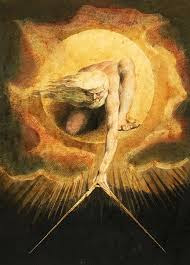
"The Ancient of Days", William Blake 


The observer is central to every circle whose focus is appointed by intention. The act of observing appears as a disturbance within a quantum field of virtual potential, i.e. a position of single pointedness is known by means of its impression upon the greater whole. The point becomes a line giving direction (measure) to its purpose and meaning to its intent. A point is a line in motion. (see Design Metaphysics: Design In Motion)

Multidimensional and holistic in essence the point no longer appears pointless as it hurls through a field of virtual potential. Splitting from itself for purposes of self realization, the point becomes both one (particle) and the same (wave) - expanding beyond pointlessness (line, wave, geometry) a reflection of its self returns to its pointedness (center, source, intent). Experience invites an expansion and contraction of the field within. Forms emerge and disappear in a feedback loop that never ends. What was once real now changes every moment. Projection, reflection, internalization, illumination ... cyclically spiraling, expanding and contracting in a Design revealed in moments of timeless Awareness.


“The present issues from the past, and the future from the present. Everything is made one by this continuity. Time is like a circle, where all the points are so linked that one cannot say where it begins or ends, for all points precede and follow one another forever.” Hermes Trismegistus, Corpus Hermeticum 
- Hermeticism: The Ancient Wisdom of Hermes Trismegistus
Design is irrational. Design can be imagined, but not always measured.

Design is not as precise as mathematics would like it to be, yet without it nothing would add up.

The design process is dependent upon the proper use of language made in reference to the concept of coherent resonance. If a common language, i.e. system of symbolic impression and interpretation, is not appropriately pre-determined, agreed upon and adhered to through a shared and accepted understanding, truth will surely be lost in interpretation, transformation and transcendence This is an extremely difficult position to comply with and adapt to considering the fact that change is a constant and most reactive when observed from within a quantum field of virtual potential and probability (QFVPP).

The observer/perceiver interprets every event and experience (situation) symbolically. The observer both absorbs (input) and responds (output) with a coded language of signs and symbols recognized solely within the context and constraints that surround every observation.

An observer never stands alone for there will always appear a context upon reflection.

To be design conscious you must be more than an observer.

* * *

Your text presents a rich, philosophical exploration of observation, design, and meaning within a quantum field of potential. Below is a refined and expanded version that deepens specific themes while enhancing clarity and impact. 

The Observer and the Design of RealityThe observer is the central reference point in every circle of perception, where intention serves as the axis of focus. Observation itself introduces a shift—an energetic ripple—within a quantum field of virtual potential. What appears as a mere point of awareness is revealed through its interaction with the whole, creating an imprint that defines its presence. The point, by virtue of its own existence, extends into a line—directional, purposeful, and imbued with intent. Motion transforms the static into the dynamic; a point is a line in motion. 

Yet, the point is never merely a singularity. It is multidimensional, holistic, and self-referential, continuously moving through the vast field of potentiality. As it ventures beyond its initial state, it undergoes a process of self-realization—splitting and expanding, manifesting as both particle and wave, form and energy, identity and dissolution. The once-isolated point dissolves into patterns of motion—lines, waves, geometries—each a reflection of itself returning to its origin. This cyclical interplay of expansion and contraction mirrors the fundamental nature of existence: emergence and disappearance, creation and dissolution, all within an infinite feedback loop. Reality, as experienced, is fluid—ever-changing, shifting moment by moment in response to perception. 

The Irrational Elegance of Design: Design, by its very nature, is paradoxical. It can be imagined, yet not always measured; it is structured, yet resists strict definition. While mathematics seeks precision, design reveals an underlying irrationality—an unseen order that cannot always be quantified. Without design, nothing would add up, yet design itself remains elusive, often beyond the grasp of pure logic. 

At its core, the design process relies on language—on a coherent system of symbolic representation and interpretation. Without a shared agreement on meaning, without an established resonance of understanding, truth risks being distorted, lost in layers of perception, transformation, and transcendence. This challenge is magnified within a quantum field of virtual potential and probability (QFVPP), where observation itself alters the observed. Change is a constant, a force in flux, and meaning shifts most dramatically when viewed from within the field of endless possibility. 

The Observer, the Symbol, and the Reflection: The act of perception is inherently symbolic. Every event, every experience, every moment of awareness is filtered through a personal and collective lexicon of signs and symbols. The observer does not passively witness reality; rather, they actively interpret it—absorbing and responding to the world through encoded meaning. Perception is always situated within a context, shaped by the constraints and conditions surrounding it. An observer is never truly alone, for even in solitude, meaning arises through reflection—context appearing in the wake of awareness. 

To be truly design-conscious, one must transcend mere observation. To see beyond the surface, to recognize patterns within chaos, to understand the resonance of meaning within structure—this is the path of intentional creation. The observer must become the designer, engaging not just with the seen, but with the unseen forces that shape reality itself. 

This version refines key themes—observation, quantum potential, design, language, and interpretation—while enhancing clarity and impact. 

The author generated this text in part with GPT-3, OpenAI’s large-scale language-generation model. Upon generating draft language, the author reviewed, edited, and revised the language to their own liking and takes ultimate responsibility for the content of this publication.


* * *


"To believe is to accept another's truth.
To know is your own creation."
Anonymous


Edited: 02.11.2021, 02.15.2021, 02.16.2021, 03.01.2021, 03.24.2021, 04.12.2021, 04.29.2021, 07.13.2021, 12.01.2021, 02.08.2022, 03.15.2022, 03.28.2023, 03.21.2025, 11.16.2025

Find your truth. Know your mind. Follow your heart. Love eternal will not be denied. Discernment is an integral part of self-mastery. You may share this post as long as author, copyright and URL https://designmetaphysics.blogspot.com/ is included as the resource and shared on a non-commercial no charge basis. Please note … posts are continually being edited over time. Copyright © 2023 C.G. Garant. All Rights Reserved. (Fair use notice) You are also invited to visit https://designconsciousness.blogspot.com/ and https://sagariandesignnetwork.blogspot.com and https://www.pinterest.com