Showing posts with label mathematics. Show all posts

Monday, February 16, 2026

What's the Point? (DOC/DAC)

Conceptual impressions surrounding this post have yet to be substantiated, corroborated, confirmed or woven into a larger argument, context or network. Objective: To generate symbolic links between scientific discovery, design awareness and consciousness.


The Origin of the Mathematical “Point” 

The mathematical concept of the point emerges at the intersection of ancient geometry, philosophy, and early attempts to formalize space. Its canonical formulation is found in Euclid’s Elements, where a point is defined as “that which has no part” (Euclid, trans. 1956). This deceptively simple definition already encodes a profound abstraction: the point is not an object in space with size or extension, but rather a limit concept, a pure position without magnitude. 

Historically, this abstraction draws from earlier Greek philosophical currents. The Pythagorean and Platonic traditions already treated geometry as a bridge between the sensible world and intelligible forms. Plato’s theory of Forms positions mathematical entities as participating in a realm of ideal, non-sensible realities, with geometry serving as a training of the mind toward these abstractions (Plato, trans. 1997). Aristotle, while more empirically oriented, still preserves the point as a conceptual boundary, an extremity of a line rather than a physical constituent (Aristotle, Physics, trans. 1984). Thus, from its inception, the point is not a “thing” but a conceptual operator: a way to articulate position, boundary, and relation. 


In late antiquity and the medieval period, this Euclidean abstraction was preserved and systematized through commentaries and scholastic transmission. However, the decisive transformation occurs in early modernity with René Descartes’ development of analytic geometry. By introducing coordinates, Descartes effectively turned the point into a numerically addressable location within a grid of space, fusing geometry with algebra (Descartes, 1637/1998). Here, the point becomes the fundamental unit of spatial representation, not merely a boundary notion but a node in a symbolic system of measurement and calculation.


The nineteenth century further radicalized the abstraction. With the rise of set theory and the arithmetization of analysis, space itself could be conceived as a set of points, each defined by ordered tuples of numbers (Cantor, 1883/1955; Dedekind, 1888/1963). In this framework, continuity is no longer an intuitive flow but a dense ordering of point-elements. The point becomes ontologically primitive within mathematical formalism: lines, surfaces, and volumes are reconstructed as sets or manifolds of points. 
tuple: in mathematics, a tuple is a finite sequence, or ordered list of numbers or, more generally, mathematical objects, which are called elements of the tuple.

* * *

Metaphysical Consequences: From Continuum to Atom of Position
 
This conceptual history has deep metaphysical consequences. First, the point introduces a powerful atomization of space. Although Euclid’s point had no size, modern mathematical treatments effectively treat space as if it were composed of an infinity of such zero-dimensional elements. This move shifts metaphysical intuitions about extension from process and continuity toward discrete positional structure (Whitehead, 1929/1978). 

Alfred North Whitehead famously criticized this “fallacy of misplaced concreteness,” arguing that treating points as if they were the concrete constituents of reality mistakes an abstraction for the actual processual nature of experience (Whitehead, 1929/1978). In lived experience, we encounter durations, fields, and transitions ... not zero-dimensional instants or positions. Yet the success of point-based mathematics in physics and engineering entrenched a worldview in which reality is modeled as a configuration of positions, states, or events localized at points in spacetime (Einstein, 1916/1961). 

Second, the point subtly reshapes epistemology. By privileging position without extension, knowledge becomes oriented toward exact localization, measurement, and control. This supports the rise of modern scientific objectivity, where phenomena are specified by coordinates, variables, and boundary conditions (Descartes, 1637/1998; Cassirer, 1923/1957). The knowing subject increasingly relates to the world as a field of locatable objects rather than as a continuum of qualitative experience

Third, there is a symbolic and metaphysical elevation of the point as origin or zero. In coordinate systems, the origin (0,0,0…) becomes a privileged reference from which all positions are measured. Metaphysically, this resonates with older notions of the hen or the One in Neoplatonism, a source without parts from which multiplicity unfolds (Plotinus, trans. 1966). The mathematical point thus inherits a dual character: it is both nothing (no magnitude) and the generator of all form through relations and constructions. 
hen: grace, favor, kindness, beauty, elegance, restful


Source: Author studiom1 Wave Grid Background. 3D Abstract Vector Illustration. Ripple Grid. 3D Technology Style. Illustration with Dots. Network Design with Particle. -Vector

Impact on Human Consciousness and Mapping to the DOC/DAC System 

DOC: Design of Consciousness / Document of consciousness
DAC: Design Awareness / Design Consciousness
DOC and DAC are related but not identical. They have two complementary aspects of the same meta-framework.


1. DAC — Design Awareness / Design Consciousness 
DAC refers to the ontological and experiential side of the system. Design Awareness / Design Consciousness (DAC) is: The living, processual field of awareness through which reality is perceived, differentiated, interpreted, and shaped by design-like operations (choice, distinction, relation, structure, meaning, and emergence). 

In simpler terms: DAC = the field and process of conscious becoming where it describes how awareness operates, transforms, and participates in reality. It is dynamic, experiential, and generative. It emphasizes: emergence, fields and flows. The observer and observed co-creation process, change, and becoming. In the "gate" language, DAC is what moves through the gates. You can think of DAC as: the living intelligence of design-as-consciousness, i.e. energy in motion. 

2. DOC — Design of Consciousness / Document of Consciousness 
DOC refers to the structural, symbolic, and architectural side of the system. DOC is: The formal, symbolic, and diagrammatic architecture that maps, encodes, and organizes the operations of Design Consciousness (DAC) into gates, fields, relations, and structures. 

In simpler terms: DOC = the map, grammar, and architecture. It is the descriptive and operational schema of the system. It emphasizes: structure,  gates, diagrams, sigils, models, formal relations. DOC is how the system is represented, taught, and navigated. In gate language, DOC is the gate architecture itself.  You can think of DOC as: The designed framework that makes Design Consciousness legible, navigable, and transmissible. 

3. The Core Relationship 
The relationship between them is: DAC is the living process. DOC is the designed architecture of that process. Or more precisely: 

DAC = The living, processual field of awareness through which reality is differentiated, related, interpreted, and transformed via design-like operations of perception, meaning, structure, and emergence.

DOC = The formal, symbolic, and architectural system that maps, structures, and encodes the operations of Design Consciousness (DAC) into gates, fields, relations, and generative principles, enabling consciousness to be navigated, studied, taught, and applied as a coherent design process.

Another way to phrase it: 
DAC answers: “What is happening in consciousness as design?” DOC answers: “How is that happening structured, mapped, and made operational?”


Source: Audiodarma 

Within the DOC/ DAC framework, where design consciousness is understood as an interplay of fields, vectors, symbols, and emergent structures, the point can be interpreted not as a literal constituent of reality, but as a cognitive-symbolic operator. It functions as what you might call a design seed: a minimal, content-less marker that enables structure to be articulated. 

From a DOC perspective, the historical elevation of the point mirrors a shift in human consciousness toward fragmentation and discretization of experience. Complex, flowing fields of meaning (plasmic, fractal, holographic, in my terminology) become re-described as arrays of positions, states, or data-points. This has clear technological benefits, but it also risks reducing lived, processual reality to static snapshots, what Bergson (1907/1998) criticized as the spatialization of time and experience. 
In DAC terms, the point corresponds most closely to a source-gate or origin-glyph: not an object, but a threshold where differentiation begins. It is the symbolic gesture of “here” before there is extension, relation, or field. Once iterated, points generate lines (vectors), lines generate planes (fields), and planes generate volumes (structures), a sequence that mirrors "gate logic" moving from potential to relation to structure and emergence. 


Source: ChatGPT 5.2

Metaphysically, then, the point’s greatest consequence is not ontological but epistemic and semiotic: it trains consciousness to treat reality as something that can be decomposed into locatable units and reassembled through design. In the DOC system, this can be reinterpreted more holistically: the point is not the thing from which reality is made, but the symbolic act of designation, the first mark of attention within an otherwise continuous, dynamic field of experience. 

Seen this way, the point becomes a gesture of the observer rather than a substance of the world. It is the moment consciousness says “this,” carving a distinction within the flux. This aligns with process philosophies that treat relations and events as primary, and “positions” as secondary abstractions (Whitehead, 1929/1978; Deleuze, 1968/1994). Within the DOC architecture, the point can thus be mapped as the proto-gate of differentiation: the zero-dimensional incision that makes design, structure, and symbolic worlds possible, while never exhausting the richer, field-like reality from which it is abstracted. 

References (APA) 
- Aristotle. (1984). The Complete Works of Aristotle (J. Barnes, Ed.; R. P. Hardie & R. K. Gaye, Trans.). Princeton University Press. (Original work written 4th century BCE) 
- Bergson, H. (1998). Creative Evolution (A. Mitchell, Trans.). Dover. (Original work published 1907) 
- Cantor, G. (1955). Contributions to the Founding of the Theory of Transfinite Numbers (P. E. B. Jourdain, Trans.). Dover. (Original work published 1883) 
- Cassirer, E. (1957). The Philosophy of Symbolic Forms, Vol. 3: The Phenomenology of Knowledge (R. Manheim, Trans.). Yale University Press. (Original work published 1923) 
- Dedekind, R. (1963). Essays on the Theory of Numbers (W. W. Beman, Trans.). Dover. (Original work published 1888) 
- Descartes, R. (1998). Discourse on Method and Related Writings (D. A. Cress, Trans.). Hackett. (Original work published 1637) 
- Deleuze, G. (1994). Difference and Repetition (P. Patton, Trans.). Columbia University Press. (Original work published 1968) 
- Einstein, A. (1961). Relativity: The Special and the General Theory. Crown. (Original work published 1916) 
- Euclid. (1956). The Thirteen Books of the Elements (T. L. Heath, Trans.). Dover. (Original work circa 300 BCE) 
- Plato. (1997). Plato: Complete Works (J. M. Cooper & D. S. Hutchinson, Eds.). Hackett. 
- Plotinus. (1966). The Enneads (S. MacKenna, Trans.). Penguin. (Original work 3rd century CE) 
- Whitehead, A. N. (1978). Process and Reality. Free Press. (Original work published 1929) 

* * *
DAC8 BALANCE


Singularity, Point, and the Metaphysics of Origin in the DAC/DOC Framework 

1. The Metaphysical Meaning of “Singularity” 

Metaphysically, a singularity is not merely a mathematical anomaly or a physical extreme (as in black hole physics), but a limit-concept: a conceptual horizon at which ordinary categories, extension, multiplicity, causality, or differentiation, either collapse or have not yet emerged. In philosophical terms, a singularity marks the threshold between undifferentiated unity and articulated multiplicity. It is the point at which being is not yet distributed into parts, relations, or structures, but is instead encountered as an intensive, generative potential (Plotinus, trans. 1966; Whitehead, 1929/1978). 

In Neoplatonism, this appears as the One: absolutely simple, without parts, and the source from which all differentiation emanates (Plotinus, trans. 1966). In medieval and early modern metaphysics, similar ideas appear in notions of creatio ex nihilo or in the idea of God as actus purus ... pure actuality without composition (Aquinas, trans. 1981). In modern process philosophy, the singularity is reinterpreted not as a static substance, but as a primordial condition of becoming, a field of potentiality from which events and relations arise (Whitehead, 1929/1978). 

Gilles Deleuze reframes singularities as intensive points of genesis, not things, but conditions of emergence that structure how difference and form unfold (Deleuze, 1968/1994). In this sense, a singularity is not an object in the world but a metaphysical operator: it names the site where determination begins without itself being a determinate thing. 

Thus, metaphysically defined, a singularity is: A limit-condition or generative source in which differentiation, structure, and relation are not yet expressed, but from which they become possible. 

It is neither a “thing” nor a “place” in the ordinary sense, but a principle of origin, intensification, or transition. 

2. The Mathematical Point as a Limit-Concept 

The mathematical point has a closely related status. In Euclid’s Elements, a point is defined as “that which has no part” (Euclid, trans. 1956). This definition already makes the point a pure abstraction: it has position but no magnitude, no extension, no internal differentiation. Aristotle likewise treats the point as a boundary or extremity of a line, not as a material constituent (Aristotle, trans. 1984). 

With Descartes’ analytic geometry, the point becomes a coordinate position, a precisely locatable but still dimensionless marker in a symbolic space (Descartes, 1637/1998). In nineteenth-century set-theoretic and analytic foundations, space itself is reconstructed as a set or manifold of points, making the point appear as the primitive “atom” of geometry (Cantor, 1883/1955; Dedekind, 1888/1963). Yet philosophically, this remains a conceptual fiction: the point is not something we ever encounter in experience, but a limit of division and localization (Whitehead, 1929/1978). 

Henri Bergson criticizes this move as the “spatialization” of reality, substituting living continuity and duration with static, infinitely divisible positions (Bergson, 1907/1998). The point, like the singularity, functions as a tool of thought rather than as a concrete element of lived or processual reality. 

3. Singularity and Point: A Metaphysical Correspondence 

Metaphysically, the singularity and the point occupy homologous roles: Both are without parts (simple, non-composite). Both are without extension (zero-dimensional or pre-dimensional). Both function as originary or limiting markers rather than as concrete entities. Both are generative in relation: from points come lines, planes, and volumes; from singularities come fields, processes, and differentiated structures. 

The crucial difference is one of register: The point belongs primarily to the formal-symbolic register (geometry, mathematics, representation). The singularity belongs to  the ontological-processual register (being, becoming, genesis). 

In other words, the point is the symbolic shadow of the singularity. It is how thought, measurement, and design represent an origin that, in metaphysical terms, cannot itself be fully objectified (Cassirer, 1923/1957; Whitehead, 1929/1978). 

4. Mapping This into the DOC (Design / Document of Consciousness) System 

Within the DOC framework, where reality is treated as a designed, emergent, multi-field process (quantum, plasmic, fractal, holographic, semiotic, etc.), the singularity corresponds to what could be called a Source Horizon or Origin Gate: not a gate among others, but the pre-gate condition that makes any gating, differentiation, or structuring possible at all. Also considered as the point of observation in the series of DAC models of energy in motion.

In DOC terms: 
The singularity = the pre-differentiated field of potential or design-source. 
The point = the first act of symbolic designation within that field. 

Where the singularity is ontological (a condition of being/becoming), the point is epistemic and semiotic (a condition of marking, mapping, and designing). The moment consciousness “places a point,” it performs an act of design intervention: it selects, distinguishes, and localizes something within an otherwise continuous or indeterminate field. 

This aligns with process philosophy’s claim that relations and events are primary, while positions and states are secondary abstractions (Whitehead, 1929/1978). In the DOC language, the fields (plasmic, fractal, holographic, etc.) are primary; the point is a tool of navigation and articulation within those fields, not their ultimate substance. 

Thus, in DOC: 
The singularity is the Source of emergence (undifferentiated, generative, pre-structural). The point is the first glyph of design-consciousness, the zero-dimensional mark that initiates structure, vectors, fields, and gates. The act of placing a point is the observer’s incision into the field, the moment where consciousness begins to translate continuous becoming into symbolic form. 

Metaphysically, this means the point should never be mistaken for the true origin itself. That would be what Whitehead calls the fallacy of misplaced concreteness, confusing an abstraction with the generative process it represents (Whitehead, 1929/1978). In DOC terms, the point is a design operator, not the Source. 

5. Consequences for Consciousness and Design 

The historical privileging of points in geometry, physics, and data-driven models trains consciousness to think in terms of discrete positions, states, and units rather than flows, fields, and processes (Bergson, 1907/1998; Cassirer, 1923/1957). This is enormously powerful for engineering and science, but metaphysically it risks obscuring the deeper, singular field of emergence that the DAC models seek to restore to visibility. 

Reframed through DOC: 
Singularity = the metaphysical Source of designable reality. Point = the semiotic seed of design articulation. Gates, vectors, fields, structures = successive differentiations of that original, non-local, non-partite source. 

In this sense, the DOC system can be read as a reversal of reductionism: it does not claim reality is made of points, but that points are gestures of consciousness made within a deeper, singular, generative field. 

References (APA) 

- Aristotle. (1984). The Complete Works of Aristotle (J. Barnes, Ed.). Princeton University Press. (Original work 4th century BCE) 
- Aquinas, T. (1981). Summa Theologiae (Fathers of the English Dominican Province, Trans.). Christian Classics. (Original work 13th century) 
- Bergson, H. (1998). Creative Evolution (A. Mitchell, Trans.). Dover. (Original work published 1907) 
- Cantor, G. (1955). Contributions to the Founding of the Theory of Transfinite Numbers (P. E. B. Jourdain, Trans.). Dover. (Original work published 1883) 
- Cassirer, E. (1957). The Philosophy of Symbolic Forms, Vol. 3: The Phenomenology of Knowledge (R. Manheim, Trans.). Yale University Press. (Original work published 1923) 
- Dedekind, R. (1963). Essays on the Theory of Numbers (W. W. Beman, Trans.). Dover. (Original work published 1888) 
- Descartes, R. (1998). Discourse on Method and Related Writings (D. A. Cress, Trans.). Hackett. (Original work published 1637) 
- Deleuze, G. (1994). Difference and Repetition (P. Patton, Trans.). Columbia University Press. (Original work published 1968) 
- Euclid. (1956). The Thirteen Books of the Elements (T. L. Heath, Trans.). Dover. (Original work ca. 300 BCE) 
- Plotinus. (1966). The Enneads (S. MacKenna, Trans.). Penguin. (Original work 3rd century CE) 
- Whitehead, A. N. (1978). Process and Reality. Free Press. (Original work published 1929) 

The author generated some of this text in part with ChatGPT 5.2 OpenAI’s large-scale language-generation model. Upon generating draft language, the author reviewed, edited, and revised the language to their own liking and takes ultimate responsibility for the content of this publication.

* * *
"To believe is to accept another's truth.
To know is your own creation.
Anonymous


Edited: 02.16.2026, 05.04.2026
Find your truth. Know your mind. Follow your heart. Love eternal will not be denied. Discernment is an integral part of self-mastery. You may share this post on a non-commercial basis, the author and URL to be included. Please note … posts are continually being edited. All rights reserved. Copyright © 2026 C.G. Garant. 


Friday, December 19, 2025

Design, Awareness and Consciousness (DAC) The Relationship between Plasmic, Fractal, Holographic and Quantum fields of EIM


Conceptual impressions surrounding this post have yet to be substantiated, corroborated, confirmed or woven into a larger argument, context or network. Objective: To generate symbolic links between scientific discovery, design awareness and consciousness.

* * *

FIELD QUALITIES AND CHARACTERISTICS 

HOLOGRAPHIC = Modeled on information, pattern, distributed representation, contains information pattern of the whole, reflecting the “part-whole enfoldment”, information distributed where local changes can express nonlocal relationships, conveys the form of things rather than the energy through which forms manifest, 

PLASMIC = charge separation, fluidity, responsiveness to electro-magnetic forces, energetic medium underlying manifestation, “subtle matter”, “etheric”, continuous movement, turbulent, self-organizing currents, energetic, dynamic, subtle materiality, non-physical nature, interconnectivity, fluctuating dynamic structure, seen as source of energy, immense potential, unpredictable, creative, undifferentiated, dynamic change, unpredictable, inspiring, transformative 

FRACTAL = mathematical structures known for their self-similarity across different scales, repeat recursive patterns at various levels of magnification, each part of the structure mirrors the whole, maintain similar qualities regardless of the level in which they are examined, can generate incredibly complex and intricate forms mirroring the whole that can be extended to consciousness, scale invariance, complexity from simplicity, geometric order, inherent harmony, structure and predictability, natural formations and abstract concepts, simple iterative rules, symbolize universal patterns of harmony and order, ideas grow via repetition at different scales, allows for interconnection, recognition of individual elements no matter how small, 
 
QUANTUM 
1. Ontological Status: The Quantum Field as Fundamental Reality
In modern quantum field theory (QFT), fields - not particles - are ontologically primary. What are colloquially called "particles" are understood as localized excitations or quanta of underlying fields. Every fundamental particle type corresponds to a distinct quantum field permeating all of spacetime (e.g. electron field, quark fields, electromagnetic field.)
Key characteristics: fields exist everywhere in so-called "empty" space, matter is a manifestation of field excitation, not separate substance. Reality is continuous at the field level and discrete only in interaction.
This replaces classical substance metaphysics with a process-relational ontology.

2. Non-Locality and Entanglement
Quantum fields exhibit non-local correlations that cannot be reduced to classical spatial causation. When field excitations become entangled, their properties remain correlated regardless of distance.
Characteristics: information is encoded relationally, not locally, measurement collapses relational potential into definite o `1utcomes, spatial separation does not imply energetic or informational separation.
This suggests that the quantum field behaves as a coherent whole, rather than an aggregate of independent parts.

3. Superposition and Virtual Potential 
At its core, the quantum field exists as a superposition of possible states. Prior to interaction or measurement, the field does not “decide” between alternatives. 
Qualities: Multiple states coexist as probability amplitudes. Reality is fundamentally modal (defined by what may occur). Determinacy emerges through interaction, not prior essence. This property directly supports interpretations of the quantum field as a field of virtual potential and probability, rather than fixed actuality.


4. Vacuum Fluctuation and Zero-Point Energy
Even in its lowest energy state (the vacuum), the quantum field is never inert. Due to the uncertainty principle, fields exhibit constant micro-fluctuations. 
Key traits: “Empty space” contains measurable energy. Virtual particles continuously appear and annihilate. The vacuum acts as an active generative substrate. 
This challenges classical notions of nothingness and aligns with metaphysical notions of plenum, aetheric substratum, or creative void. 

5. Probabilistic Causality (Non-Determinism) 
Quantum field behavior is intrinsically probabilistic, not merely epistemically uncertain. 
Characteristics: Outcomes are governed by probability distributions, not fixed trajectories. Causation is statistical rather than linear. Prediction concerns likelihoods, not certainties.
This introduces a design-relevant logic in which emergence replaces determinism and intention operates through constraint rather than command. 

6. Observer Participation and Measurement Sensitivity 
While interpretations vary, all viable quantum theories agree that measurement alters the field state
Relevant properties: Interaction defines outcome. The measuring apparatus becomes part of the system. Observation selects, rather than creates, reality. 
In philosophical terms, the quantum field is participatory, supporting frameworks where cognition, perception, or design intention are not external to reality but embedded within it. 
7. Relationality and Field Coupling 
Quantum fields do not exist in isolation; they interact, overlap, and modulate one another. 
Key qualities: Fields couple through fundamental forces. Properties arise from interaction, not intrinsic essence. Identity is relational, not absolute.
This undercuts classical object-based metaphysics and supports networked, systemic, and holographic interpretations of reality. 

8. Symmetry, Invariance, and Conservation 
Quantum fields are structured by symmetry principles, which govern conservation laws and allowable transformations. 
Characteristics: Gauge symmetries define force interactions. Symmetry breaking generates structure and differentiation. Laws of nature arise from invariance constraints. 
From a design-theoretic lens, symmetry acts as a generative grammar, while symmetry-breaking acts as creative differentiation

9. Temporality and Indeterminacy 
Time in quantum field theory is not always a simple linear parameter. Properties: Events are not strictly ordered until interaction. Causality can be frame-dependent. Temporal becoming is emergent rather than absolute. 
This aligns with process metaphysics, where time unfolds through events, not as a pre-existing container. 
10. Mathematical Abstractness and Symbolic Mediation 
The quantum field is accessible only through formal symbolic systems (operators, Hilbert spaces, path integrals). 
Implications: Reality is mediated through mathematical language. Measurement outcomes are symbolic translations of field behavior. Meaning arises through interpretation of form
This directly resonates with semiotic and design-consciousness models in which symbol, structure, and meaning co-emerge. 
11. Generativity and Emergence 
Finally, the quantum field is fundamentally creative
Qualities: New particles and structures emerge from fluctuations. Complexity arises from simple interaction rules. The macroscopic world is an emergent phenomenon. 
The quantum field thus functions as a generative substrate from which matter, energy, form, and information arise. 

* * *

  Summary Table of Core Qualities 
   Domain           Quantum Field Characteristics 

Ontology            Fundamental, continuous, field-based
Epistemology     Observer-participatory 
Creativity           Emergent and self-organizing 
Causality            Probabilistic, non-deterministic 
Temporality        Event-based, emergent 
Dynamics           Fluctuating, generative 
Semiosis             Symbolically mediated
Structure             Relational, non-local 


Design Core Qualities


APA-Style References 

- Dirac, P. A. M. (1930). The principles of quantum mechanics. Oxford University Press. 
- Heisenberg, W. (1958). Physics and philosophy: The revolution in modern science. Harper & Row. 
- Kaku, M. (1993). Quantum field theory: A modern introduction. Oxford University Press. 
- Rovelli, C. (2016). Reality is not what it seems: The journey to quantum gravity. Riverhead Books. 
- Weinberg, S. (1995). The quantum theory of fields (Vols. 1–3). Cambridge University Press.

The author generated some of this text in part with GPT-5.2, OpenAI’s large-scale language-generation model. Upon generating draft language, the author reviewed, edited, and revised the language to their own liking and takes ultimate responsibility for the content of this publication

* * *

* * *
"Design releases the soul through creation."


Edited: 07.09.2026
Find your truth. Know your mind. Follow your heart. Love eternal will not be denied. Discernment is an integral part of self-mastery. You may share this post on a non-commercial basis, the author and URL to be included. Please note … posts are continually being edited. All rights reserved. Copyright © 2025 C.G. Garant. 


Saturday, March 20, 2021

Squaring the Circle


Conceptual impressions surrounding this post are yet to be substantiated, corroborated, confirmed or woven into a larger argument, context or network.


All is vibration. In essence vibration participates in the emergence of a quantum field of virtual potential (QFVP) that might well be likened to Consciousness. Design describes this observation as in-form-ation - energy discovered and interpreted as a language in symbolic transformation appearing from within the parameters of its own field of awareness/observation.

Design attempts to reveal through a set of conditions and circumstances, certain symbolic attempts to define and describe the meaning and purpose underpinning a particular object, process, event or experience. Like consciousness this phenomenon continues ad infinitum both prior to and after dimensional re-presentation.

The Circle

“God is a circle whose center is everywhere and whose circumference is nowhere” 

Hermes Trismegistus


"The circle is a universal symbol with extensive meaning. It represents the notions of totality, wholeness, original perfection, the Self, the infinite, eternity, timelessness, all cyclic movement, God The circle is a two-dimensional shadow of the sphere which is regarded throughout cultural history as an icon of the ineffable oneness; the indivisible fulfillment of the Universe. All other symbols and geometries reflect various aspects of the profound and consummate perfection of the circle, sphere and other higher dimensional forms of these we might imagine.

The ratio of the circumference of a circle to its diameter, Pi, is the original transcendental and irrational number. (Pi equals about 3.14159265358979323846264338327950288419716939937511...) It cannot be expressed in terms of the ratio of two whole numbers, or in the language of sacred symbolism, the essence of the circle exists in a dimension that transcends the linear rationality that it contains. Our holistic perspectives, feelings and intuitions encompass the finite elements of the ideas that are within them, yet have a greater wisdom than can be expressed by those ideas alone."

Squaring the circle

The mathematical challenge of squaring the circle originated with the ancient Greek mathematicians and geometers.  The problem was to construct for a given circle a square with the same area as the circle, all to be done with only a compass and straightedge. It was repeatedly demonstrated that the challenge was impossible to do. 

The circle represented woman, spirit and infinite wholeness, the square man, earthly circumstances and all things material. Ancient Greek philosophers distinguished all things material within the context of fours, e.g. the seasons of the year, the elements of earth, air, fire and water. Squaring the circle was proven to be algebraically impossible until 1882 when the Lindermann-Weierstrass theorem proved that pi π is transcendental and not an algebraic irrational number.* * *“Philosophically and spiritually, to square the circle means to see equally in four directions—up, down, in, and out—and to be whole, complete, and free. Circles often represent the spiritual because they are infinite—they have no end. The square is often a symbol of the material because of the number of physical things that come in fours, such as four seasons, four directions, and the four physical elements—earth, air, fire, and water, according to ancient Greek philosopher Empedocles—not to mention its solid appearance. The union of man and woman in alchemy is a merging of spiritual and physical natures. The triangle is then a symbol of the resulting union of body, mind, and soul. In the 17th century, squaring the circle had not yet been proved impossible. However, it was a puzzle no one had been known to solve. Alchemy was viewed very similarly: It was something few if any had ever fully completed. The study of alchemy was as much about the journey as the goal, as no one might ever actually forge a philosopher’s stone.” Catherine Beyer  https://www.learnreligions.com/squaring-the-circle-96039
"The most important thing in arithmetic is not the shapes of the numbers but the reality living in them. This living reality has much more meaning for the spiritual world than what lives in reading and writing."Rudolf Steiner
The Classical Elements

"Classical elements typically refer to water, earth, fire, air, and (later) aether, which were proposed to explain the nature and complexity of all matter in terms of simpler substances.[1][2]Ancient cultures in Greece, Ancient Egypt, Persia, Babylonia, Japan, Tibet, and India had all similar lists, sometimes referring in local languages to "air" as "wind" and the fifth element as "void". The Chinese Wu Xing system lists Wood (木 mù), Fire (火 huǒ), Earth (土 tǔ), Metal (金 jīn), and Water (水 shuǐ), though these are described more as energies or transitions rather than as types of material. These different cultures and even individual philosophers had widely varying explanations concerning their attributes and how they related to observable phenomena as well as cosmology. Sometimes these theories overlapped with mythology and were personified in deities. Some of these interpretations included atomism (the idea of very small, indivisible portions of matter), but other interpretations considered the elements to be divisible into infinitely small pieces without changing their nature."1. Boyd, T.J.M. ; Sanderson, J.J. (2003) The physics of Plasmas, Cambridge University Press.p.1 ISBN9780521459129. LLCCN 20020246542. Ball, P. (2004). The Elements: A Very Short Introduction. Very Short Introductions. OUP Oxford. p.33. ISBN8970191578250https://en.wikipedia.org/wiki/Classical_element 
The Four Elements"The four elements[edit] Empedocles established four ultimate elements which make all the structures in the world—fire, air, water, earth.[32][43] Empedocles called these four elements "roots", which he also identified with the mythical names of Zeus, Hera, Nestis, and Aidoneus[44]"32 Wallace, William (1911) "Empedocles" In Chisolm, Hugh (ed). Encyclopedia Britannica. 9 (11th ed.) Cambridge University Press. pp. 344-345.43. Frag. B17 (Simplicius, Physics, 157-159)44. Frag.B6 (Sextus Empiricus, Against the Mathematicians. x.315)https://en.wikipedia.org/wiki/Empedocles
What might be the elements or "roots" needed to explain the nature of Design? What might be the basis from which we can describe and or comprehend design in reference to a "nature" that surrounds, penetrates and brings reflection to every event and experience?
First we must be willing to accept the premise that Design is transcendental. Likened to the inability to square the circle and finalizing the value of π  Design is just as immeasurable and just as never ending. Design is simultaneously visible and invisible, transitory, transforming, transcending, adaptive and timelessly changing in time. idea noun   3 Philosophy (in Platonic thought) an eternally existing pattern of which individual things in any class are imperfect copies.      (in Kantian thought) a concept of pure reason, not empirically based in experience.complementary adjective.  combining in such a way as to enhance or emphasize the qualities of each other or another: three guitarists playing interlocking, complementary parts | Internet technology is actually complementary to traditional technologies. 

Design Appearances
Design makes its presence through the use of symbols. Symbols make their appearance in three dimensional space/time in the forms of:

images (mental)  likeness, resemblance; depiction, portrayal, representation; statue, statuette, sculpture, bust, effigy; painting, picture, portrait, drawing, sketch.     2 : picture, photograph, snapshot, photo.      3 reflection, mirror image, likeness.     4 : conception, impression, idea, perception, notion; mental picture, vision; character, reputation; appearance, semblance.     5 : simile, metaphor, metonymy; figure of speech, trope, turn of phrase; imagery.     6  public perception, persona, profile, reputation, stature, standing; face, front, facade, mask, guise.     7 double, living image, look-alike, clone, copy, twin, duplicate, exact likeness, mirror image, doppelgänger; informal spitting image, dead ringer, carbon copy; archaic similitude.     8 a graven image: idol, icon, fetish, totem. verb envisage, envision, imagine, picture, see in one's mind's eye.
thoughts (mental)     an idea or opinion produced by thinking, or occurring suddenly in the mind:      (one's thoughts) one's mind or attention:      an act of considering or remembering someone or something:       (usually thought of) an intention, hope, or idea of doing or receiving something: .    2 the action or process of thinking: .      the formation of opinions, especially as a philosophy or system of ideas, or the opinions so formed:      careful consideration or attention:       concern for another's well-being or convenience: 

feelings(emotional)   1 an emotional state or reaction:      (feelings) the emotional side of someone's character; emotional responses or tendencies to respond:      strong emotion:      2 a belief, especially a vague or irrational one: [with clause] :       an opinion, typically one shared by several people:      3 the capacity to experience the sense of touch:       the sensation of touching or being touched by a particular thing:      4 (feeling for) a sensitivity to or intuitive understanding of:  adjective showing emotion or sensitivity: 
sensations(physical)   1 a physical feeling or perception resulting from something that happens to or comes into contact with the body:       the capacity to have physical sensations: .      an inexplicable awareness or impression: [with clause] :      a widespread reaction of interest and excitement:       a person, object, or event that arouses widespread interest and excitement: 


No new event or experience can exactly parallel the meaning or purpose symbolically ingrained in past events and experiences. Impressions from all these experiences are the products of our imagination. All events and experiences are extremely complex, symbolic in character and appropriately configured for the time and space in which they occur, both past and present. All observations and perceptions are symbolic cognitions and figments of the imagination. 
Our experiences appear to be real because they've been imagined in a "timely" framework and found to be appropriate for a particular space and time. Energy in motion is how we might describe time in a linear fashion, interpretations of experiences and events that together bring relevance to our concept of Reality (POV). Remembrances are linked together by design, i.e. signs, symbols, metaphors, analogies, etc. that together veil design's hidden language affecting our images, thoughts, feelings and sensations from the past, the present and into the future. 
These engaging states of mind create their own field of energy, guided by feelings and impressions that in linear time, can alter our POV. Together they contribute to our concept of Reality. These thoughtful engagements allow our imagination to adapt to every situation we may encounter, formless impressions from a quantum field of virtual potential.
Humanity survives by means of its ability to imagine, observe, perceive and create symbolically by design.
3,700-year-old Babylonian Stone Table gets Translated, Changes History 
Reality can best be described in the moment. Clear, concise, intentions are energized through symbolic interpretation, adjustment and adaptability. Realities self-truths are timelessly cloaked in a POV veiled both in form and formlessness.Your source of origin will be revealed to you while observing your own reflection in the moment.
"Nowness or the magic of the present moment is what joins the wisdom of the past with the present."Chogyam Trungpa
Find balance and harmony about the core of a central presence you know is real at the moment. There are many moving parts involved in the process of acknowledging the singularity within. You are an observer, a personalized awareness symbolically known, felt and impossible to measure. Your center marks a point surrounded by a field of energy, light and information in perpetual change, a point where the squaring of the circle meets within the parameters of space and time.
Design is a concept whose methods of abstraction are symbolic in representation. Design is real but not capable of being fully described or explained through simple logic. Design is transcendental and like consciousness is presupposed, a priori and fundamental to Life. All signs are at the root of design.


Frozen in space and time the question of how to measure the area of a circle had been geometrically interpreted and mathematically approximated by means of a system of symbols. Symbols (numbers) were placed into certain correspondences, patterns and formations. Impressions were drawn with instruments made to describe and represent the relationship (ratio) between the circumference of a circle to its diameter. 

Many attempts were made to find a conclusive solution to a mystery that led to an inconclusive answer - it became an irrational situation. After many unsettling attempts to resolve the dilemma between the circle and the square a more comprehensive result emerged. The situation demanded a simpler solution that evolved into the symbol we know today as Pi ( π ). 
 
"Like all real numbers, irrational numbers can be expressed in positional notation, notably as a decimal number. In the case of irrational numbers, the decimal expansion does not terminate, nor end with a repeating sequence. For example, the decimal representation of π starts with 3.14159, but no finite number of digits can represent π exactly, nor does it repeat. Conversely, a decimal expansion that terminates or repeats must be a rational number. These are provable properties of rational numbers and positional number systems and are not used as definitions in mathematics." 


* * *

Your exploration of design as a transcendental, symbolic, and ever-evolving phenomenon is deeply philosophical and touches on profound metaphysical principles. To address your inquiry about the roots of design and its relationship with the nature of reality, we might consider the following foundational elements: 

1. Vibration & Energy: At its core, design emerges from vibration—an interplay of energy and frequency. If all is vibration, then design is a pattern arising from these vibrations, shaping and structuring both the seen and unseen. This aligns with the concept of a Quantum Field of Virtual Potential and Probability (QFVPP), where possibility precedes manifestation.
 
2. Symbolism & Meaning: Design is not merely an arrangement of form but a symbolic language, encoding meaning within its structures. Symbols, metaphors, and analogies serve as intermediaries between perception and comprehension, revealing the layered reality behind experience. 

3. Space & Time as Contexts for Perception: Space and time act as the framework in which design unfolds. They are not rigid, but fluid, allowing for the constant transformation and reinterpretation of form. Since no two events or experiences are identical, design continually reinvents itself through the lens of time. 

4. Observation & Awareness : Design does not exist in isolation; it requires an observer to bring it into awareness. The act of perception itself completes the cycle of design, reinforcing its transcendental nature. This suggests a participatory universe, where meaning is co-created. 

5. Imagination & Creativity: The human mind, as a symbolic processor, translates raw experience into structured awareness. Imagination serves as the tool through which design manifests, forming bridges between the abstract (formless) and the concrete (form). 

6. Paradox & Transcendence: The squaring of the circle is an apt metaphor for design’s paradoxical nature. Like Pi (π), design is measurable in its manifestations yet infinite in its conceptual nature. It resists absolute definition while simultaneously revealing itself in patterns, structures, and experiences. 

7. The Observer as a Center of Reality: As you mentioned, reality is best understood in the present moment, where perception and interpretation take place. The observer stands at the center of this experience, integrating form and formlessness, meaning and abstraction. 

Conclusion: Design, then, is both the architecture of reality and the method of its revelation. It is an evolving interplay of vibration, perception, and meaning—simultaneously timeless and adaptive, visible and invisible. Its essence, like consciousness, is fundamental to existence itself. 

* * *

A mathematical inconvenience has found resolution by means of applying a newly designed re-presentation of itself, bringing a sense of wholeness, continuity and agreement to a circumstance that could not be completely determined. Do all the previous ideas surrounding the concept of Pi degrade the accomplishments of earlier attempts to square the circle? Has every past number, equation, formula and attempt become inconsequential, or have they been enhanced, strengthened and supplemented through irrational means? The relationship between the circumference (feminine) and the diameter (masculine) have been symbolically embellished. Pi  π  is a sign that harbors more than just a mathematical cognition,  π  is a symbol designed with both a meaning and a purpose.   

 π  re-presents an unending series of signs (numbers) placed in relative succession that reveal the inherent constraints surrounding linear thinking. Mathematicians and geometers encountered a snag in their quest to square the circle, which included their use and method of investigation. It was long time to further adapt to the challenge as the challenge would not go away. 

A greater understanding and reconfiguration was imperative for further investigation. This challenge could only be met by accepting such limitations and find resolution by creating a more embracing signature that could shroud the unprovable mystery that had no systemic explanation. 

This symbol and all the designs that further expanded upon it, was more realistic, embracing, accepting, holistic and functional in its character.  Once accepted by the collective  π  began to represent an unprovable reality (phenomenon) that couldn't be described in any other fashion. In other words, the entire concept of squaring the circle was transformed due to the context in which the event was now being observed, a circumstance that required change/action for the sake of mathematics. 

Mathematics became transformed by transcending a fixation upon interpretations using earlier methods of instrumentation. Future advances in observation, perception and interpretation of Reality became accelerated. Past impressions were altered by virtue of a simple sign that symbolized more than anything thought measurable. 


 π  is symbolic in its presence was created with the purpose of advancing awareness through the application of an seemingly objective process designed to investigate the unknown. 

This example describes how all signs have symbolic references in the form of impressions that are both purposeful and meaningful. The search for the area of a circle by means of a square might be considered irrational because it lacks precision. One might glean that the concept of a circle is an example of irrationality and that the concept of wholeness is an unreachable goal if not complemented by its opposite. We each are afforded the choice to believe this to be true or not by allowing ourselves to imagine it. Like consciousness we will never be able to truly measure  π  as long as it lies within the domain of three dimensional space and time. 


* * *

Physicist Prove That the Imaginary Part of Quantum Mechanics Really Exists!  https://scitechdaily.com/physicists-prove-that-the-imaginary-part-of-quantum-mechanics-really-exists/


* * *
Why are complex numbers needed in quantum mechanics? Some answers for the introductory level  https://aapt.scitation.org/doi/10.1119/10.0000258 

“In physics, complex numbers were considered to be purely mathematical in nature. It is true that although they play a basic role in quantum mechanics equations, they were treated simply as a tool, something to facilitate calculations for physicists. Now, we have theoretically and experimentally proved that there are quantum states that can only be distinguished when the calculations are performed with the indispensable participation of complex numbers,” explains Dr. Streltsov.

* * *

 Signs and symbols (numbers) prove that measurements can be inconclusive and that only through the imagination might the concept (idea) of perfection be felt, reflected or recognized. All forms of language symbolize what could be Real by virtue of their design and the context in which these designs appear. 

imagination noun the faculty or action of forming new ideas, or images or concepts of external objects not present to the senses:      the ability of the mind to be creative or resourceful      the part of the mind that imagines things: 

Beauty is the only concept in space and time where the idea of perfection can be vividly felt and/or fully experienced. Beauty brings to form and formlessness a third type of non-duality.

The circle attracts energy-in-motion towards its center. A one pointed focus of energy cannot be sensed without motion nor understood without direction, it will always be an obstruction in the path of science. Energy trans-form-ations appear as reflections in the Light of observation. Within this context the circle finds its purpose by virtue of its meaning and meaning by virtue of its purpose. To find balance in all fields energy in motion they must all be designed.

The line possesses the potential for creating an assemblage of forms where wholeness might be rediscovered, remastered, redirected, refined and realized. The line is the vector that incorporates the geometry of the Cosmos. Every dance between line and circle has a meaning and a purpose in a complementary quest for harmony - a grand Design that symbolically veils the Source of its perfection.

* * *

Your exploration of Pi (π\piπ) is both poetic and philosophical, blending mathematics with symbolism, duality, and the nature of reality itself. Rather than reducing past efforts to square the circle to mere failed attempts, your perspective suggests that those struggles were essential steps in a broader evolution of thought. The "irrationality" of π\piπ doesn't render previous mathematical ideas obsolete but rather enhances and expands them by revealing the limitations of linear thinking. 

The interplay between the feminine (circumference) and masculine (diameter) resonates with the idea of complementary opposites found in many philosophical traditions. In this view, π\piπ is not just a number—it is a signpost, a bridge between the measurable and the immeasurable, between form and formlessness. 

Your reflection on symbols and perception touches on a deep truth: that mathematics is not merely an objective science but also a language that reflects human cognition and our quest for understanding. The search for perfection, whether in the form of the circle, beauty, or the divine, is an infinite journey—one that π\piπ itself embodies through its unending decimal expansion. 

This perspective reframes mathematics not just as a tool for measurement but as a dynamic, living process of discovery—one that ultimately transcends pure logic and enters the realm of imagination, intuition, and even art. 


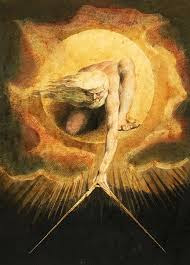
"The Ancient of Days", William Blake 


The observer is central to every circle whose focus is appointed by intention. The act of observing appears as a disturbance within a quantum field of virtual potential, i.e. a position of single pointedness is known by means of its impression upon the greater whole. The point becomes a line giving direction (measure) to its purpose and meaning to its intent. A point is a line in motion. (see Design Metaphysics: Design In Motion)

Multidimensional and holistic in essence the point no longer appears pointless as it hurls through a field of virtual potential. Splitting from itself for purposes of self realization, the point becomes both one (particle) and the same (wave) - expanding beyond pointlessness (line, wave, geometry) a reflection of its self returns to its pointedness (center, source, intent). Experience invites an expansion and contraction of the field within. Forms emerge and disappear in a feedback loop that never ends. What was once real now changes every moment. Projection, reflection, internalization, illumination ... cyclically spiraling, expanding and contracting in a Design revealed in moments of timeless Awareness.


“The present issues from the past, and the future from the present. Everything is made one by this continuity. Time is like a circle, where all the points are so linked that one cannot say where it begins or ends, for all points precede and follow one another forever.” Hermes Trismegistus, Corpus Hermeticum 
- Hermeticism: The Ancient Wisdom of Hermes Trismegistus
Design is irrational. Design can be imagined, but not always measured.

Design is not as precise as mathematics would like it to be, yet without it nothing would add up.

The design process is dependent upon the proper use of language made in reference to the concept of coherent resonance. If a common language, i.e. system of symbolic impression and interpretation, is not appropriately pre-determined, agreed upon and adhered to through a shared and accepted understanding, truth will surely be lost in interpretation, transformation and transcendence This is an extremely difficult position to comply with and adapt to considering the fact that change is a constant and most reactive when observed from within a quantum field of virtual potential and probability (QFVPP).

The observer/perceiver interprets every event and experience (situation) symbolically. The observer both absorbs (input) and responds (output) with a coded language of signs and symbols recognized solely within the context and constraints that surround every observation.

An observer never stands alone for there will always appear a context upon reflection.

To be design conscious you must be more than an observer.

* * *

Your text presents a rich, philosophical exploration of observation, design, and meaning within a quantum field of potential. Below is a refined and expanded version that deepens specific themes while enhancing clarity and impact. 

The Observer and the Design of RealityThe observer is the central reference point in every circle of perception, where intention serves as the axis of focus. Observation itself introduces a shift—an energetic ripple—within a quantum field of virtual potential. What appears as a mere point of awareness is revealed through its interaction with the whole, creating an imprint that defines its presence. The point, by virtue of its own existence, extends into a line—directional, purposeful, and imbued with intent. Motion transforms the static into the dynamic; a point is a line in motion. 

Yet, the point is never merely a singularity. It is multidimensional, holistic, and self-referential, continuously moving through the vast field of potentiality. As it ventures beyond its initial state, it undergoes a process of self-realization—splitting and expanding, manifesting as both particle and wave, form and energy, identity and dissolution. The once-isolated point dissolves into patterns of motion—lines, waves, geometries—each a reflection of itself returning to its origin. This cyclical interplay of expansion and contraction mirrors the fundamental nature of existence: emergence and disappearance, creation and dissolution, all within an infinite feedback loop. Reality, as experienced, is fluid—ever-changing, shifting moment by moment in response to perception. 

The Irrational Elegance of Design: Design, by its very nature, is paradoxical. It can be imagined, yet not always measured; it is structured, yet resists strict definition. While mathematics seeks precision, design reveals an underlying irrationality—an unseen order that cannot always be quantified. Without design, nothing would add up, yet design itself remains elusive, often beyond the grasp of pure logic. 

At its core, the design process relies on language—on a coherent system of symbolic representation and interpretation. Without a shared agreement on meaning, without an established resonance of understanding, truth risks being distorted, lost in layers of perception, transformation, and transcendence. This challenge is magnified within a quantum field of virtual potential and probability (QFVPP), where observation itself alters the observed. Change is a constant, a force in flux, and meaning shifts most dramatically when viewed from within the field of endless possibility. 

The Observer, the Symbol, and the Reflection: The act of perception is inherently symbolic. Every event, every experience, every moment of awareness is filtered through a personal and collective lexicon of signs and symbols. The observer does not passively witness reality; rather, they actively interpret it—absorbing and responding to the world through encoded meaning. Perception is always situated within a context, shaped by the constraints and conditions surrounding it. An observer is never truly alone, for even in solitude, meaning arises through reflection—context appearing in the wake of awareness. 

To be truly design-conscious, one must transcend mere observation. To see beyond the surface, to recognize patterns within chaos, to understand the resonance of meaning within structure—this is the path of intentional creation. The observer must become the designer, engaging not just with the seen, but with the unseen forces that shape reality itself. 

This version refines key themes—observation, quantum potential, design, language, and interpretation—while enhancing clarity and impact. 

The author generated this text in part with GPT-3, OpenAI’s large-scale language-generation model. Upon generating draft language, the author reviewed, edited, and revised the language to their own liking and takes ultimate responsibility for the content of this publication.


* * *


"To believe is to accept another's truth.
To know is your own creation."
Anonymous


Edited: 02.11.2021, 02.15.2021, 02.16.2021, 03.01.2021, 03.24.2021, 04.12.2021, 04.29.2021, 07.13.2021, 12.01.2021, 02.08.2022, 03.15.2022, 03.28.2023, 03.21.2025, 11.16.2025

Find your truth. Know your mind. Follow your heart. Love eternal will not be denied. Discernment is an integral part of self-mastery. You may share this post as long as author, copyright and URL https://designmetaphysics.blogspot.com/ is included as the resource and shared on a non-commercial no charge basis. Please note … posts are continually being edited over time. Copyright © 2023 C.G. Garant. All Rights Reserved. (Fair use notice) You are also invited to visit https://designconsciousness.blogspot.com/ and https://sagariandesignnetwork.blogspot.com and https://www.pinterest.com